There is a wide range of attractions on the island of Aruba. On this page
we provide information on some of those attractions. Simply click on the
link below to obtain information on that attraction.
During the colonial period, Aruba and many of her
Caribbean neighbors experienced an influx of immigrants from throughout the world. As
Aruba was once a colony of The Netherlands, the Dutch influence on Aruban culture is still
strong and many current residents are descendants of Dutch colonizers. However, because of
the diversity of peoples that have called this island home, daily life in Aruba continues
to be influenced by African, South American and native Caribbean cultures. Nowhere is this
exciting diversity more apparent than in houses of worship found throughout Aruba. Though
the island remains predominantly Catholic, nearly all of the world's major religions are
represented by the local population. Most importantly for tourists, Aruba features a
wealth of special religious sites where visitors of all faiths can experience peaceful
scenery and explore historic architecture.
One of the most photographed sights in Aruba is the beautiful Chapel of Alto Vista. Resting above the Caribbean Sea on
an incredible bluff, this bright yellow chapel has long been a special destination for
locals and tourists alike. Before you even arrive at the site, the white crosses lining
the road to the chapel - signifying the Catholic Stations of the Cross - will let you know
you've found a uniquely peaceful place. As the chapel was built during colonial times by
both Spaniards and native Indians, the chapel is also referred to as the Pilgrim's Church.
No matter what you call it, the chapel provides one of Aruba's most serene and captivating
experiences.
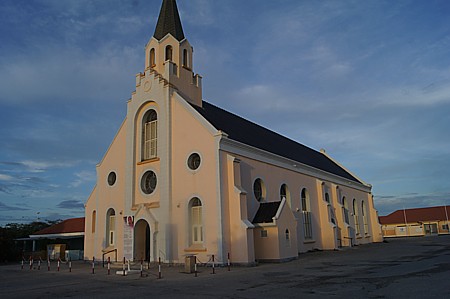
The Santa Ana Catholic Church, also known as
the Church of Noord, features one of the finest examples of Neo-gothic sculpture in the
Caribbean. The incredible altarpiece was crafted in 1870 by Dutch artisan Hendrik van der
Geld and was met with great accolades at the first Vatican Council, held that same year in
Rome. After spending some time in residence at the Antonius Church in The Netherlands, the
altarpiece was given to the Santa Ana Church in Aruba. The Santa Ana Catholic Church was
first constructed in 1776 and was rebuilt twice in the 19th century. The church was last
renovated in 1916 and today remains one of the island's most important buildings. Located
just outside of Aruba's capital of Oranjestad, the Santa Ana Catholic Church is a
fascinating piece of the island's history that can be enjoyed by visitors of all faiths.
While the Santa Ana Catholic Church and the Chapel of Alto Vista were first constructed
in the 18th century, Aruba's Protestant Church represents
the island's oldest original house of worship. Erected in 1846 to support Aruba's growing
Protestant population, the elegant church is known for its terracotta roof, large tower
and traditional wooden shutters. As the exterior is also adorned with simplistic folk-art
decorations including hearts and stars, the church is often compared to the finest
structures of Pennsylvania Dutch country. Though the Protestant Church is usually locked,
visitors can explore the grounds - including the quaint Bible museum - each weekday from
10am to 12pm.
Jewish families visiting Aruba often visit the Beth Israel Synagogue, a pleasant house
of worship dating to the early 20th century. While the Jewish population in Aruba numbers
only 35 families today, the synagogue was once an important cultural center for Caribbean
and European immigrants. However, over the years, the Beth Israel Synagogue has become an
important destination for travelers. Today, most of the families visiting the synagogue
for Friday night services are tourists enjoying a spiritual home away from home. The Beth
Israel Synagogue also features a small gift shop that sells a variety of uniquely Aruban
Judaica.
While many of the churches of Aruba are certainly worth a visit, one of the most
interesting religious sights on the island is the Lourdes Grotto. Located just off the
picturesque leading from San Nicolas to the northeastern coast, the Lourdes Grotto is
located in one of Aruba's most peaceful locales. In 1958, a priest and his parishioners
carefully tucked a statue of the Virgin Mary weighing several hundred pounds into the
blackened hillside known as Seroe Preto. Much like the famous Catholic landmark in France
from which the grotto borrows its name, this hillside shrine has become an important
destination for locals and tourists alike. Each year on the feast day of Our Lady of
Lourdes (February 11), a large procession of local Catholic and curious visitors embark on
a procession from the St. Theresita Church in San Nicolas to hold mass at Lourdes Grotto.
As the island of Aruba has recently passed a marriage law allowing travelers to wed on
the island, these unique religious landmarks have also become the sites for many beautiful
ceremonies. While the best of resorts in Aruba are able to provide accommodations and
lavish receptions, many of these houses of worship can offer visiting couples an
opportunity to celebrate their union in a peaceful and spiritual environment. While it may
not be possible to wed in some of Aruba's churches, couples hoping to tie the knot on the
island can contact their resort and work with a wedding specialist to secure the best
location for their ceremony.
Whether you want to attend services or simply see some unique historical sites, the
churches of Aruba welcome all visitors with open arms. As many of the island's houses of
worship sit in remarkably peaceful locales, tourists can also take time to relax and
witness incredible scenery. Regardless of your faith, the churches of Aruba provide some
of the most captivating sights on the island.
Justin Burch writes articles about travel
in Aruba for the Marriott Resorts.
Throughout Aruba are many well preserved and well maintained churches.
Perhaps the most visited is the Alto Vista Chapel, however another church
that is worthy of a visit is the St Ann's Catholic Church. Located in the
Noord district at the intersection of Route 2 ( Caya Frans Figaroa) and
Route 3, a short distance from the high rise hotel area of Palm Beach. This
church and adjacent cemetery is a worthwhile stop on any tour of Aruba
attractions.
The St Ann's Church was originally founded in 1776 after the chapel at Alto
Vista fell into disuse. Originally built of mud bricks the church was
rebuilt with regular bricks in 1813 and then rebuilt again in 1885. In
1916, further construction work was done on this church. In 2011, the roof
had to be repaired after a tornado tore the roof off the building.
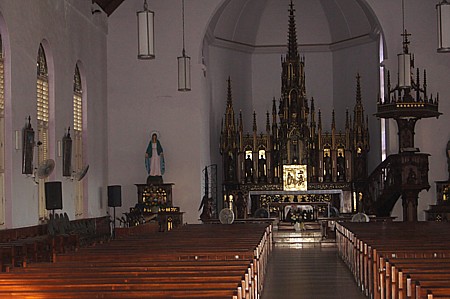
Within the church is an impressive oak altarpiece constructed in 1865 and
donated to the Church in 1928 by the Antonius
church in Scheveningen, Netherlands. The cross within the church dates from
1909 and the stained glass windows are from 1932.
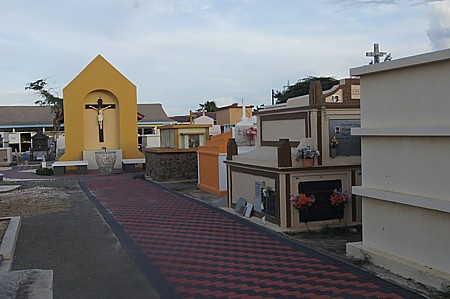
The adjoining cemetery displays an Aruban tradition of burying the dead in
above ground crypts. Far from being a depressing place these cemeteries are
like mini-villages with streets and apartments. The cemetery at St Ann's
Church is a neat clean place.
Respect and love for departed family members is shown by the many flowers
that adorn the front of each crypt. Another interesting Aruban tradition is
that many of the crypts have a photograph of the deceased on the front. It
is a human frailty that with the passage of time our memory of the
appearance of the deceased fades. The Aruban tradition of attaching a
photograph of the departed on the front of the tomb means that we are
forever able to remember what the departed looked like.
Just as the European colonizers brought many non-native
plants to the Caribbean, donkeys were transported from Spain to provide transportation and
serve in new industries. The passive, loyal animals were used in Aruba for centuries until
automobiles were introduced in the 20th century. Though some locals continued using
donkeys throughout the 1900s, many of the animals were callously discarded to roam free
across the island. For decades, several herds of donkeys survived in the wild until much
of the population was plagued by disease in the 1970s. With only 20 wild donkeys
remaining, volunteers stepped in and began developing programs to aid these unique
residents and preserve the population for future generations. However, in recent decades,
the revitalized donkey population has been plagued by new threats, including a growing
population on the island and a rapidly-expanding tourism industry. While Aruba's tourism
industry certainly allowed the local economy to flourish and brought many exciting
advancements to the island, the donkey population fell victim to more accidents and
encroachment upon their adopted habitat. Yet, just as volunteers stepped in after many of
the donkeys fell ill in the 1970s, a new organization was developed in the 1990s to offer
the donkeys a safe home.
Founded in 1997, the Aruba Donkey Sanctuary has
now provided much-needed care to local donkeys for over a decade. In
addition to providing a safe home for adult donkeys, this popular non-profit
organization has also been active in supporting a new generation of donkeys,
allowing locals and tourists alike an opportunity to interact with these
passive animals for years to come. A close-knit family of 90 donkeys shares
the facility's "Curucu di Burico" - the Donkey Field - where visitors can feed and
pet many of the animals from the enclosed patio. In the early morning hours, visiting
children are also granted an opportunity to work behind the scenes with the volunteer
staff, feeding and grooming the animals. Admission to the Aruba Donkey Sanctuary is free
for all ages, as the non-profit facility relies solely on donations and funds generated
from local donkey adoption programs.
As donkeys are incredibly resilient animals and require very
little to survive in the wild, there are still families of wild donkeys roaming the island
outside of the Aruba Donkey Sanctuary. Though there are still far fewer donkeys in Aruba
than the 1,400 counted at the beginning of the 20th century, the Aruba Donkey Sanctuary
has helped to the wild donkey population climb above 100 once again. Nearly all of the
wild donkeys in Aruba travel in groups, including the largest families of 9 and 11 animals
that roam the natural areas near the sanctuary. While these groups of donkeys are often
spotted near the Natural Bridge and the Tunnel of Love Cave - two popular natural
attractions on the northern side of the island - those interested in seeing these animals
in the wild can get more information regarding their recent whereabouts from the Aruba
Donkey Sanctuary.
The Aruba Donkey Sanctuary is easy to reach from Oranjestad and
other resort areas as the facility rests near a number of popular outdoor destinations.
Following the northern road to the Natural Bridge, visitors will see several large signs
near the Ayo Rock Formations that provide easy directions to the Aruba Donkey Sanctuary.
Travelers that want to experience some of Aruba's popular destinations as part of a guided
tour will also have a chance to see the Aruba Donkey Sanctuary, as most operators visit
the facility when touring the northern end of the island. The Aruba Donkey Sanctuary is
open to visitors on weekdays from 9 AM to 12:30 PM and on weekends from 10 AM to 3 PM.
Though Aruba's donkeys initially seemed forgotten amongst the
island's expansive tourism plans, the Aruba Donkey Sanctuary now provides the perfect
balance of preservation and one-of-a-kind sightseeing. As crowds of visitors from
throughout the world pass through the Aruba Donkey Sanctuary each year and help support
the organization's programs, the centuries-old donkey population has, in fact, become one
of the great triumphs of the island's tourism industry. When touring the picturesque north
end of the island, families can revel in this unique history by paying a visit to the
animals that silently helped make Aruba what it is today.
Whenever you visit the grocery store or pharmacy, it is probably
hard to miss the scores of products featuring Aloe Vera. Known as one of the world's
wonder plants, Aloe Vera has been incorporated into many everyday products in recent
decades because of its healing properties. As the plant is used most often as a skin
moisturizer, it perhaps comes as no surprise that world's best Aloe Vera comes from one of
the sunniest and most exotic destinations. Today, over a century after the first plants
were harvested, the island of Aruba remains one of the world's top growers of Aloe Vera.
When visiting Aruba, tourists can see the influence of the plant in many facets of Aruban
culture, purchase the some of most luxurious Aloe Vera products ever created and even tour
the plantation where the modern world's fascination with this wonder plant took root.
Though some might believe that Aloe Vera was native to the Caribbean, the plant
actually found its way to Aruba and other islands during colonial times. In fact, Aloe
Vera was completely unknown in Aruba until the mid-19th century when numerous trade
vessels from Africa visited colonial Caribbean islands. Aruba's own Aloe Vera industry
started with a modest 150-acre plantation near Hato and, within just a few decades, came
to dominate the island. By the end of the 19th century, Aruba had become the world's
largest exporter of Aloe. Today, with nearly two-thirds of the island's surface now
supporting both naturally growing and harvested Aloe Vera, it is no wonder that Aruba is
commonly referred to as the 'Island of Aloe.'
The Aloe Vera crops in Aruba are helped by the same thing that draws visitors to the
island from throughout the world each year - the weather. After the initial crops were
planted, it was realized that Aloe Vera grows incredibly well in Aruba because of the arid
conditions and consistently sunny Caribbean environment. As time went on, researchers and
growers found that the climate of Aruba also enhances the healing capabilities of the
plant, allowing the island to produce some of the most potent Aloe Vera gel in the world.
Some of the best Aloe Vera products are manufactured by Aruba Aloe, a company that
still utilizes the island's first 150-acre plantation. Six days a week, this legendary
facility opens its doors to travelers for informative tours that shed light not only on
Aruba's fascinating Aloe Vera history, but on the entire world's historic fascination with
the plant. In tracing the legend of Aloe Vera from Ancient Egypt to Aruba's colonial
period and documenting the many historical uses of the plant, Aruba Aloe offers curious
travelers a rare glimpse into the world of a wonder plant. During the daily tours,
visitors will also have a chance to see the harvesting of the Aloe Vera plants and the
production involved in converting the raw gel of the plant into some of the world's finest
medicinal and health care products.
With the original 150-acre field as the company's centerpiece, Aruba Aloe produces a
full line of products incorporating the island's purest, most potent Aloe Vera gel. Known
internationally as some of the finest Aloe-based products available, Aruba Aloe has spent
years crafting everything from hair care products to specialized lotions and moisturizers.
Meanwhile, the company has also been on the cutting edge of botanical research, developing
new uses for the plant and perfecting the art of harvesting the world's best Aloe Vera. If
you visit the Aruba Aloe factory when on the island, you will have an opportunity to
sample and purchase all of the diverse products crafted from this simple, but remarkable
plant.
Just as it is hard to miss the name Aloe Vera at your local store, you will notice the
impact this plant has had on Aruban culture as soon as you reach the island. From the
large plants dotting the Aruban countryside to the scores of products and images filling
local galleries and stores, Aloe Vera tells one of Aruba's most important stories. Though
you may visit the 'Island of Aloe' to enjoy the beaches and luxurious resorts, this wonder
plant can add an exciting element to your Caribbean vacation. After spending a few days in
the vibrant Caribbean sunshine, Aruba's Aloe Vera will probably come in handy for your
sunburn, too!
Justin Burch writes articles about travel
in Aruba for the Marriott Resorts.
From the
days of Christopher Columbus the Spanish colonizers in the Caribbean were
obsessed with finding gold and harassed the indigenous people to show them
the source of the gold that they occasionally saw the Indians wearing.
According to legends handed down, the Spanish were told that the gold came
from some treasure islands and one of these treasure islands was called Oro
Ruba which meant Red Gold. Over time that name became corrupted to what we
now know as Aruba.
Although
the Spanish conquistador Alonso de Ojeda arrived on the shores of Aruba in
1499, it was not until 1824 that gold was finally discovered in Aruba by
Europeans. The discoverer was a 12 year old boy called Willem Rasmijn who
was herding his father's sheep. This discovery created gold fever which
lasted until 1830 but began again in 1854 when new gold veins were found.
This time the rights to search for gold was given to a company and
thereafter a succession of companies explored for and processed gold in
Aruba,
In 1872
the rights were given to an English company called the Aruba Island Gold
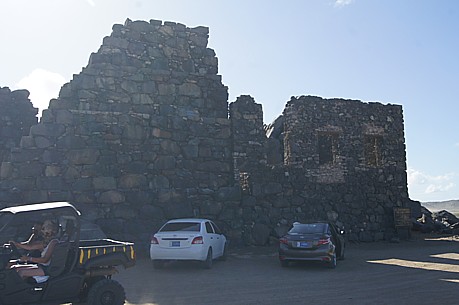
Mining Company, London and they built a gold mill at Bushiribana. The design
was created by an English architect and the walls were made of large blocks
of gabbro stone. An Aruban bricklayer Alexander Donati was the project
foreman and other bricklayers were brought from Curacao. Today the remains of that mill still exist and are visited by
tourists from around the world.
Gold
continued to be mined in Aruba until 1916 when World War I created
difficulties in obtaining the materials necessary for mining the ore. After
the war the mining was not resumed. During its operation the gold mining
industry in Aruba produced over 3 million pounds of gold. It has been said
that the methods used for producing the gold were not very efficient and
over the half the gold remained unprocessed. It may be that there is still
gold in Aruba waiting to be found, perhaps you can try your luck on your
next holiday.
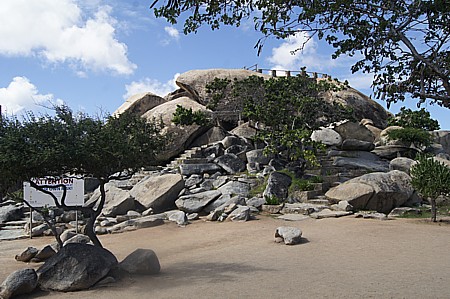
At the Casibari Rock Formations the sign says it perfectly; this is a place
to commune with God. In the midst of these rocks you find yourself pondering
the mysteries of the earth and the universe and can understand why the early
Indian inhabitants considered these formations and the Ayo Rock formations
sacred places.
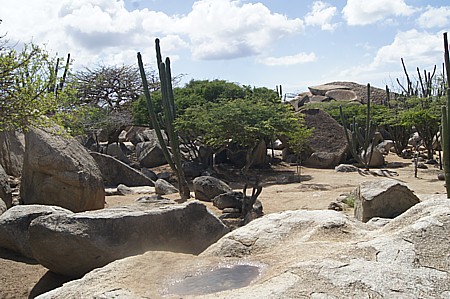
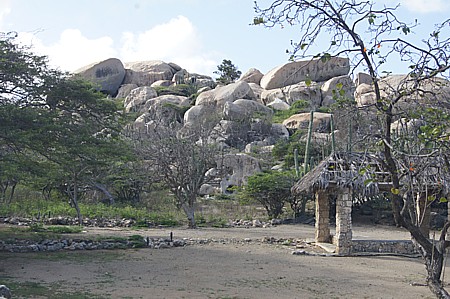
The Casibari Rock Formations are clusters of huge tonalite boulders many
weighing several tons that rise up from the desert like soil in the area
north of Hooiberg.
These boulders sit atop each other, at times looking as if they were placed
atop each other by the hands of a giant child. The Government of Aruba has
created walking trails throughout the formations and also steps to allow
visitors to attain the top of the formations.
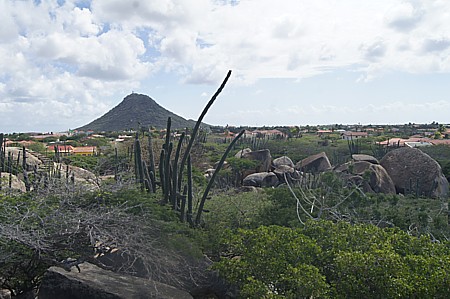
From the top of these rocks you get panoramic views of the island plus a
view of Mount Hooiberg. A picturesque time for visiting is just before
sunset so that you can witness the sunset from atop the boulders, although
it is not advisable to stay atop the boulders after dark as it becomes risky
descending the steps,
For the comfort of visitors and also to ensure the cleanliness of the
location , the Government has installed toilets at the Formation that are
free of charge. There is a cafe next door that serves drinks, food and music
and has free Wi-Fi.
Oranjestad, the capital of Aruba, is a picturesque town situated on the
southern coast near the western end of this 21 mile by 6 mile island.
Development of the town began in 1796 and originally had no name being
simply called the Bay of Horses because of the horse
trade that existed on the island. The name was conferred on the town in
the 1820's because of the discovery of gold.
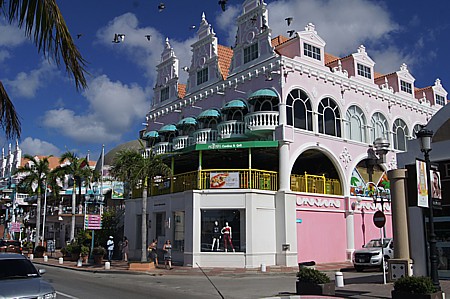
Part of the beauty of this town is the juxtaposition of modern buildings and
beautifully maintained older historical buildings. Having been a Dutch
colony and still part of the Kingdom of the Netherlands, Dutch architectural
style dominates the design of the older buildings.
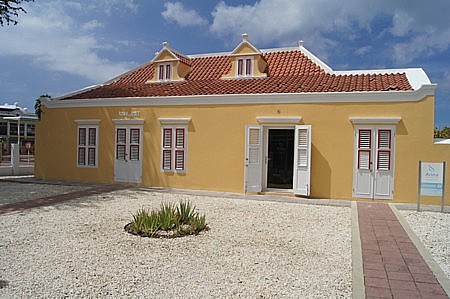
One of the examples of a beautiful preserved older building is the Arina
headquarters located on Weststraat. The building is believed to have been
constructed in 1850 and was a typical Aruban's merchant's house with an
attic and dormers. It was known as a Cunucu or countryside style house. In
1908 the house was completely renovated but in 1999 it was slated for
demolition. To preserve this historic building it was decided to completely
dismantle the house and relocate it to the site on which it presently
stands. For the relocation even the stone walls were carefully packed and
transported. Today the building is now the headquarters of the Aruba
Investment Agency.
Apart from government buildings even retail establishments and restaurants
operate in beautifully restored older buildings.
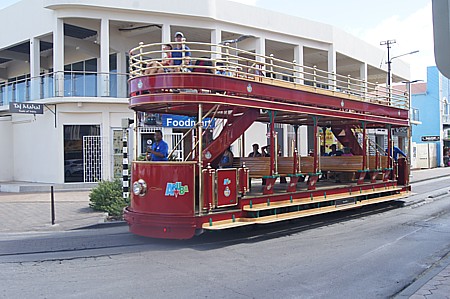
One of the other attractions of Oranjestad is the tramcars which began
operating in December 2012 and is run by the national public transportation
company, Arubus. The tramcars serve the downtown area operating daily from
9am to 5pm with 9 stops each approximately 200 meters apart.
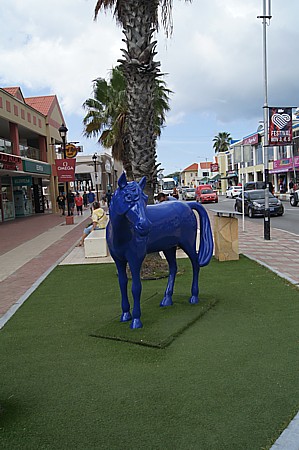
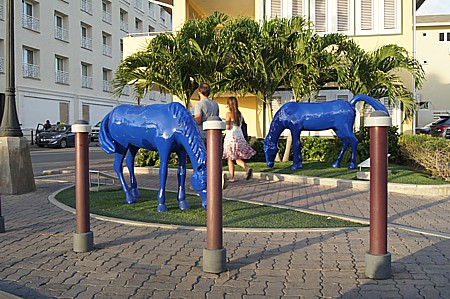
Strategically placed around the waterfront area of Oranjestad, capital of
Aruba, are several horse statues, all painted blue. These statues, each
having a different name ( Rosalinda, Saturnina, Escapia, Sinforosa,
Eufrosina, Ambrosio, Bonifacia, Celestina ) are in honor of a historical
commercial activity that provided income to the island.
In the early days of Spanish colonization Aruba was used as a source of
horses with horses being brought to the island to facilitate the
colonization projects. It is said that there were thousands of horses
roaming across the island. When the Dutch took over the island in the 17th
and 18th century the horse trade continued and only diminished in the 19th
century.
So why are these horse statues painted blue. Simply because that is a
reminder of how the horses arrived in the island.
At the time of the horse trade there was no jetty for landing the horses. So
the boats anchored offshore and the strongest willed horse was thrown in the
water first and the others then thrown in after. The first horse would
immediately swim in the direction of the shore and the others would follow.
When you visit Oranjestad take the time to visit each statue and learn more
about the quality of each horse.
When visiting Aruba, tourists often spend most of
their time near the western shore, home to the island's capital and
cultural center - Oranjestad - and most of the top beach resorts. Though
the eastern half of Aruba lacks the glamour of the western beach areas,
the area is home to many charming destinations waiting to captivate
curious travelers. As the island is only 20 miles long, the small towns
surrounding the island's second-largest city, San Nicolas, and the
incredibly diverse sights of eastern Aruba are only a short drive from
all of the top resorts.
Pos Chiquito
Located almost directly between Oranjestad and San
Nicolas along the southern coast's Route 1, the small town of Pos Chiquito
stands as one of Aruba's top destinations for scuba divers and snorkelers.
Just offshore from town, near a rugged section of shoreline known as Rocky
Beach, scuba divers and snorkelers will find one of Aruba's best coral
reefs. As the site is visited regularly by local dive tours and used as a
training ground for aspiring guides, the offshore sights at Pos Chiquito are
not exactly a secret. However, there are rarely crowds in Pos Chiquito and
the coral reef is so expansive that divers will never have trouble enjoying
this exciting underwater environment at their own pace.
While scuba diving and snorkeling are certainly the
biggest draws in Pos Chiquito, the town also has plenty to offer those in
search of simple relaxation. This quiet community is known throughout Aruba
for its refined regional architecture and laid-back atmosphere. As a
close-knit community that includes many expatriates, Pos Chiquito is also
home to an interesting variety of eateries where tourists are always
welcome.
Pos Chiquito rests just east of the island's center
along Route 1, the scenic road that stretches all the way from Boca Beach on
the northwestern shore to San Nicolas and the eastern shore. Pos Chiquito
can also be reached easily from the north end of Aruba via Routes 4 and 6.
Savaneta
Though Savaneta is home to no more than small handful
of businesses, this southern shore destination has developed a reputation as
an excellent dining destination. Though Savaneta lacks the high-class
establishments found throughout the Oranjestad and the western resort areas,
the town's eateries regularly serve up some of Aruba's best seafood and
Latin American dishes.
Savaneta also holds the distinctions of being the
oldest remaining town in Aruba - dating to the beginning of Dutch rule in
1816 - the island's original capital and site of oldest colonial home. After
exploring the historic sites, many travelers also visit some of the charming
beaches that rest just minutes from the heart of town.
Savaneta lies just east of Pos Chiquito on Aruba's
popular Route 1 and can be reached from either Oranjestad or San Nicolas in
approximately 15 minutes.
Seroe Colorado
The town of Seroe Colorado, located near the
southeastern tip of Aruba, was developed during the first half of the 20th
century as a idyllic, comfortable community for the island's growing number
of oil workers. Though many of the families have since moved to other parts
of the island, Seroe Colorado retains much of its exotic charm. Most of the
town's diminutive white houses remain intact, most flanked by dramatic cacti
plants and other natural vegetation. At the heart of town, visitors will
also find an austere chapel originally constructed in 1939.
Despite the peaceful atmosphere found in Seroe
Colorado, most visitors use the town as a gateway to the sights of Aruba's
southeastern shore. Just east of town, visitors will find a natural bridge
resting alongside a dramatic section of coastline. Despite being
less-celebrated than the Natural Bridge that collapsed in 2005 and its
remaining sister arch, Baby Bridge, the natural bridge near Seroe Colorado
offers an incredible sightseeing opportunity amongst one of Aruba's
seldom-explored areas.
Though the exposed shoreline just east of Seroe
Colorado is known for its dramatic scenery, two of the island's most popular
family beaches rest just a few miles south of town. Unlike the natural
bridge area east of Seroe Colorado, Baby Beach and Rodgers Beach are
protected by the southern tip of the island, meaning visitors will always
find calm conditions, white sand and warm, shallow water.
As Route 1 runs north of the town and access from San
Nicolas is hampered by private industrial areas, Seroe Colorado is slightly
more difficult to reach than most of Aruba's small communities. The most
efficient way to reach Seroe Colorado is to follow Route 1 east from San
Nicolas until the road terminates at a three-way intersection near the
eastern shore. From the junction, visitors can follow the shoreline road
south to Seroe Colorado and nearby beach destinations.
Though
visitors to Aruba will certainly want to spend much of their time exploring
Oranjestad and relaxing on the incomparable beaches of the western shore,
the small towns on the eastern half of the island can be enjoyed in a single
afternoon. Furthermore, as Route 1 provides easy access to many of eastern
Aruba's sights, including the city of San Nicolas, tourists have no reason
to overlook the island's quieter half.
Aruba’s
white sand, aquamarine waves and fiery sunsets look like the makings of a
watercolor. But if you can wrest your eyes from the beaches’ saturated
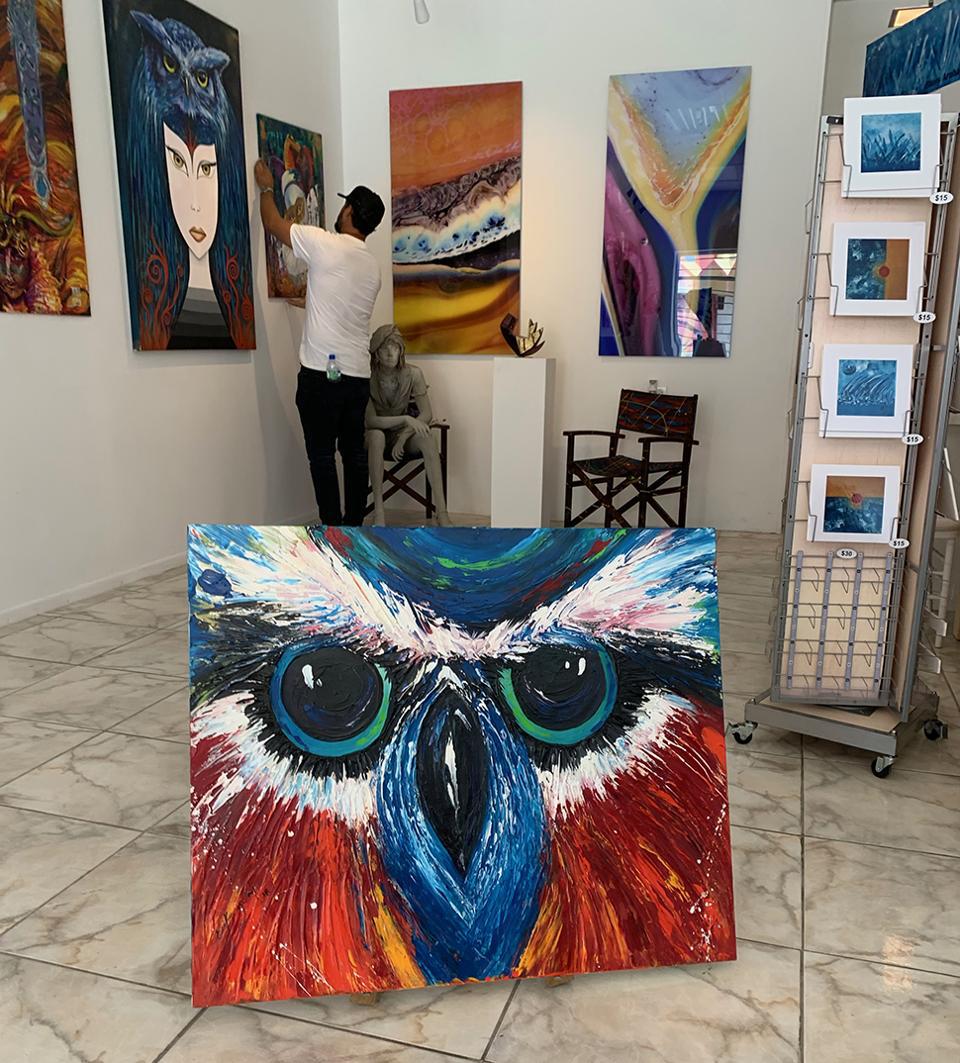
colors, you can see some real art on this Caribbean island.
From popular Palm Beach,
head about 20 miles south to San Nicolas, an emerging arts district coated
in Technicolor. Artists hailing from Argentina to Amsterdam have
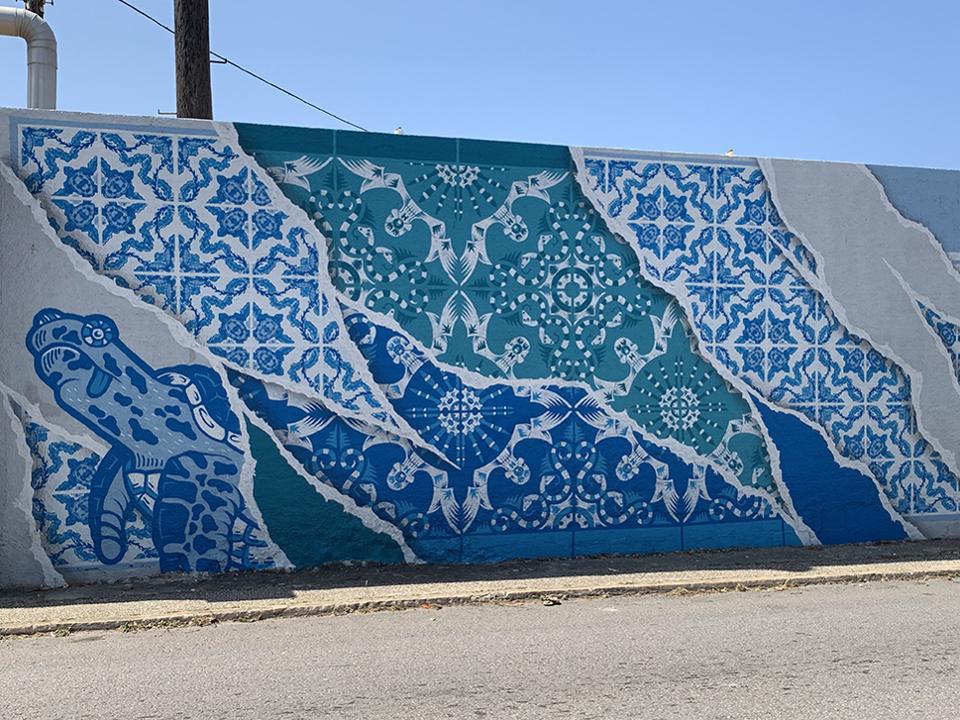
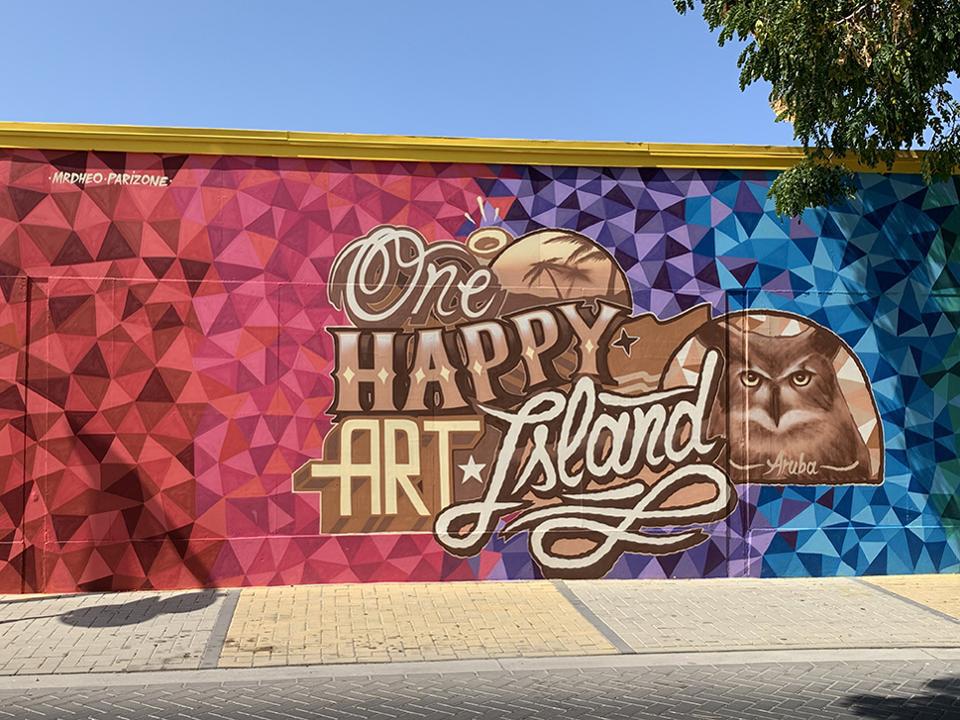
come to Aruba to create an outdoor gallery of 44 murals, many of which focus
on nature themes. Forbes
Travel Guide Recommended The
Ritz-Carlton, Aruba arranged
a private guided excursion with Aruba Mural Tours that led us through the
downtown streets followed by a workshop with a local artist to create our
own painting.
More Mural
Magic
The tour and murals mark
a new direction for San Nicolas. While it is the island’s second-largest
city (after the capital, Oranjestad), its downtown is barren. Residents and
businesses deserted the area when Exxon closed its oil refinery in 1985,
leaving empty storefronts that soon became eyesores. As San Nicolas
floundered and changed into no-man’s-land, the island and its visitors
turned their attention to Oranjestad and later Palm Beach.
Aruban Tito Bolivar
traveled to Bogota,
Colombia, in 2015 and fell in love with the city’s street art and the way it
transformed different neighborhoods. He envisioned adopting a similar
strategy back home to breathe new life into San Nicolas’ dilapidated
buildings.
But his goal to create an
artistic hub in a place known for its beaches was a cultural shift. “Art
does not live in Aruba,” he says.
Painting
Workshop with a Local Artist
JENNIFER KESTER
According to Bolivar,
art’s popularity on the island waned in the ’90s. It got a boost when a
movement called Korteweg brought together a modest gathering of people to
buy arts and crafts in a market setting in 2015. The following year, he
formed ArtisA (which stands for “Art is Aruba”), a group that organizes
local art projects, including the mural tours and the Aruba Art Fair. The
launch of the three-day fair helped revitalize the art scene — it now
attracts about 10,000 visitors each year.
When Bolivar began the
fair in 2016, he invited 100 Aruban and international artists to town.
“During the art fair we always leave murals behind as a present,” he says.
Bali Artist
WD's Iguana
JENNIFER KESTER
As we strolled the
downtown, Bolivar pointed out these gifts, which include a rainbow-hued
lionfish — whose overabundance in Aruba’s waters is threatening its reefs —
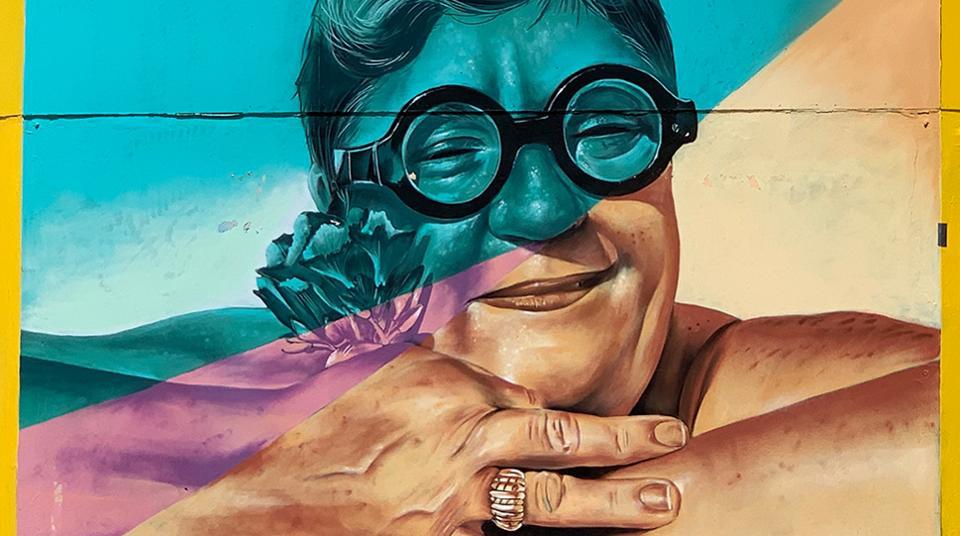
from Amsterdam artist Dopie; a cheerful portrait of Alice van Romondt, a
prominent local arts and culture advocate, by Lisbon’s
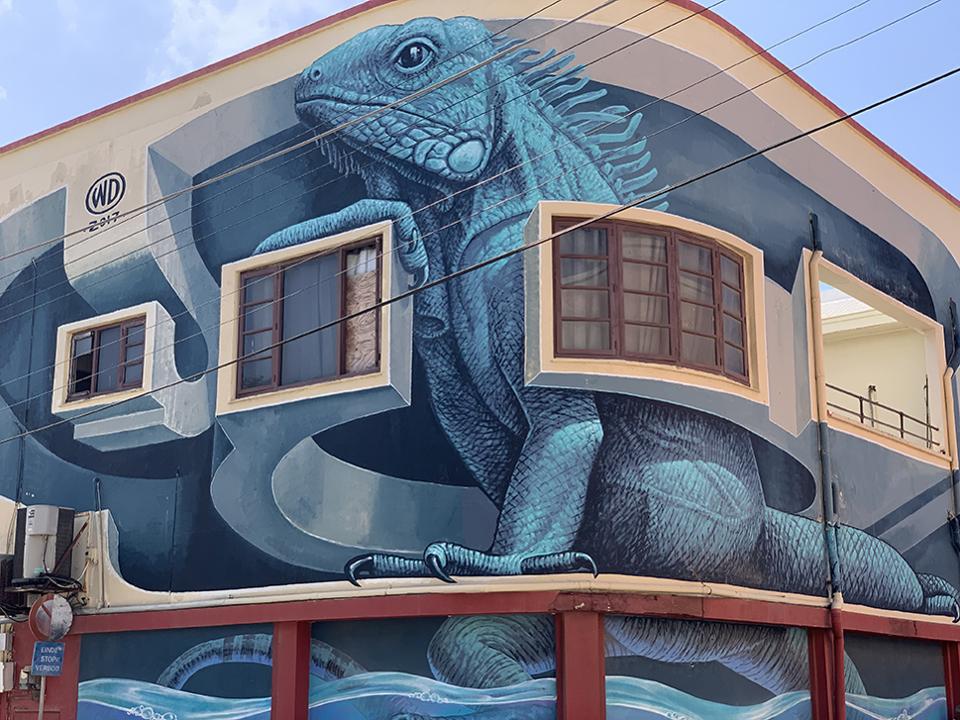
Odeith; and the ever-present iguana shaded in blue and leaning on a window
by Bali’s
WD.
Curaçao artist Garrick
Marchena uses trompe l'oeil techniques to make his subjects leap from the
canvas. One mural shows a green-feathered prikichi, Aruba’s national bird,
perched on a branch. Next to it is part of a poem by Aruban nature
photographer Damilice Mansur written in a fanciful font, “He who plants a
tree plants life, plants faith, plants shelter, plants peace, plants hope
for future generations.”
Aruba’s Street
Art Renaissance
JENNIFER KESTER
In his hyperrealist work,
Prague graffiti artist Chemis touches on politically charged topics like
pollution (an oversized brown pelican sits on an oil barrel in one piece)
and the casino industry’s influence on the island (the aqua façade of Winter
Garden bar and restaurant is covered with precariously placed cards).
The murals are becoming a
must-see attraction in Aruba. Bolivar says that it’s because they come from
high-quality artists, they tell a story and they all have the identity of
the island.
“It
has revived a forgotten city and now people from all over the world now are
visiting San Nicolas,” he says. “San Nicolas is the new place to be now.”
Though known for its exuberant night life, Aruba - especially the capital
city of Oranjestad - also offers plenty of family-friendly entertainment in
the evening hours. Within the capital city, families will find numerous
options for evening entertainment, including everything from live shows and
movie theaters to arcades and action-packed activity centers. As the city is
also known as a safe, friendly destination, families can also just stroll
through the scenic streets and admire everything from unique shops and cozy
eateries to elegant architecture and historic sights. Families hoping to
relax at their resorts may even find special weekly events designed for both
parents and children, while the top family-friendly resorts also offer
discounted travel packages that include unique upgrades for young travelers.
As
Aruba is known for its mild year-round weather, there are always plenty of
ways for families to enjoy the evening hours. Oranjestad is home to numerous
family entertainment destinations that remain open into the evening hours
throughout the year - including a popular go-kart track, a miniature golf
course and batting cages. Families can also visit a variety of arcades,
including several conveniently located within the city's top resorts. The
relaxed atmosphere of the city also allows families to simply wander the
picturesque streets, exploring shops, family-friendly eateries and historic
attractions.
The
Renaissance Cinema located in the Renaissance Marketplace is another great
choice for families in search of an entertaining evening. Showing all the
latest blockbusters in English with incredibly affordable ticket prices, the
Renaissance Cinema in downtown Oranjestad has become a favorite escape of
local and visiting families alike. Families with older children looking for
late night activities can also take advantage of the theater's popular
midnight movies each Friday and Saturday.
Though the Renaissance Cinema offers everything traveling families look for
in a movie theater - including a convenient location near most of the
island's top resorts - those exploring the island with a rental car or
recreational vehicle will want to visit one of Aruba's hidden treasures, the
E. De Veer Drive-In Theater. Located adjacent to the Balashi Brewery between
Oranjestad and San Nicolas, the E. De Veer Drive-In Theater screens many of
the latest Hollywood films, but the exotic setting and endless field of
stars are often the bigger attractions. While the E. De Veer Drive-In
Theater features low entrance fees for all films, special rates for families
are offered on Sundays and Wednesdays, allowing the whole family to enjoy
both the scenery and a movie for $6.
Many
of Aruba's top resorts stage theme nights with family-friendly entertainment
and refreshments. In nearly all cases, resorts serve locally inspired meals
alongside live entertainment that offers a taste of Aruban culture or
long-standing Caribbean traditions such as Carnival. Such live entertainment
can also be found throughout the theaters of Oranjestad, where exciting
musical and dance productions can be experienced throughout the year.
Throughout the year, several of Aruba's top resorts also offer special
promotions for families with small children. For instance, the "Escape!"
Family Package offered by the Aruba Marriott Resort and Stellaris Casino
includes special room rates for families, as well as a number of fun and
convenient perks. Each morning, both parents and kids are treated to a
complimentary breakfast, while milk and cookies are provided with each
nightly turndown service. Over the course of their stay, families can also
take advantage of pizza and movie nights presented by the resort.
From
daytime activities such as snorkeling, swimming and hiking to evening
entertainment like movies, arcades and special resort events, every day is
an action-packed adventure for visiting families. Additionally, as many of
Aruba's top resorts participate in the island's family-friendly tourism
goals, parents and children will regularly find both exciting events and
remarkable values to complete their Caribbean getaways.