One small island yet so
much to see is an apt description for Barbados. On this page we provide
information on many of the attractions that you can visit while in Barbados.
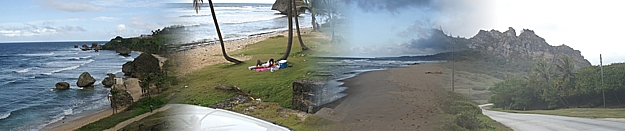
Bathsheba, the name evokes images of a mystical place and in Barbados it is a special
place. Bathsheba on the east coast of Barbados has dramatic beauty with wide sand beaches
on a rugged coast with striking rock formations. As beautiful as Bathsheba is, the journey
to this quaint seaside village is equally enchanting.
Driving to Bathsheba from Bridgetown takes one across Barbados going from the south
coast to the east coast. Going to Bathsheba can be described as a trek as the narrow
roads, old style wooden arrow-shaped signposts and striking beauty of the countryside
force you to reduce your speed and soak in the visual sights. It is a drive along narrow
roads through small villages and towns, many of whom are set in the midst of sugarcane
fields. In a sense this drive exposes you to the "true Barbados", away from the
frenetic pace of city life and the blandishments of commercial tourism. It is a drive
through villages where people stop to say good morning or wave to a passing stranger. It
is a drive through areas where people sit outside village bars or superettes and exchange
the latest news. To a lost stranger, people willingly give directions and may even offer
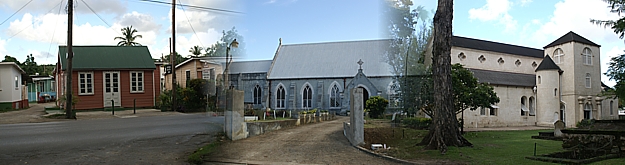
to ride part of the way. A trip to this mystical place carries you past churches that by
their very design speak of many years of ministering to a spiritual flock. If you stop and
wander the grounds of these churches a sense of peace seems to immediately envelope you.
Barbados is often thought of as a flat island but the drive across makes you realize
that there are significant hills which create striking contrasts. As you proceed the
vegetation changes, in some parts assuming a tropical rainforest appearance. The most
striking contrast however is the immediate entrance to Bathsheba. The road climbs a hill
and at the base is Bathsheba clustered around a bay with striking rock formations.
Depending however on the time of year or time of day, at the brink of the hill you are met
with a fog reminiscent of European cities. This fog is created by droplets driven by the
wind from the tops of the long Atlantic rollers.
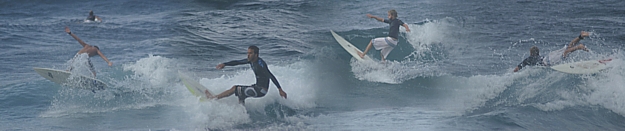
These same rollers crossing the Atlantic from Africa to crash on the Barbados shore
create ideal conditions for surfing. And so it is to Bathsheba that local and
international surfers flock. While there are many
locations in Barbados for surfing, Bathsheba takes pride of place with the famed
"Soup Bowl". Named after the foamy surf, this is the site of many local and
international surfing competitions. On almost every weekend, surfers can be seen
practicing their maneuvers on the waves while spectators lounge on the beach.
Surfing is not the only activity that takes place at Bathsheba, indeed the invigorating
salt air combined with the rock formations encourages you to explore the beach and the
surrounding village. The constant breezes are ideal for kite flying while the trails off
the beach lead you among the rocks and to cliff tops that provide dramatic views. Along
the beach are grassy areas that are perfect for picnics and weekend camping and are fully
used by locals. The wooden houses surrounding the beach seem to fit perfectly into and
enhance the environment, encouraging you to wander through the village. Scattered
throughout are restaurants and bars able to refresh a parched throat or provide a meal for
a weary traveler. As you explore further you encounter Andromeda Gardens at one end of the
village. Nestled on a cliff overlooking the east coast, Andromeda Botanic Gardens is run
by the Barbados National Trust. It is spread over six acres of carefully landscaped
grounds that are lavishly coloured with blooms, orchids, exotics and shrubs. At the other
end of the village is the neighborhood known as Cattlewash. Here are found weekend
vacation cottages sitting on a wide beach backed by dramatic cliffs and surrounded by
vegetation that has been permanently shaped by the wind.
The waters at Bathsheba encourage you to enter and swim. There are shallow pools carved
out of the inshore coral reef that are just a few feet from the shore. These pools
are several feet deep and you can sit in them while the sea rolls in and swirls around
you. Despite the free movement exhibited by the surfers, care should be exercised if
swimming in Bathsheba. Swimming should only be done if in the company of someone who knows
the area well as there are dangerous rip tides and strong undertows.
If you ever visit Barbados, take the trek to Bathsheba and invigorate your spirit with
both the drive and the magic of the place.
Every year thousands of persons flock to Barbados to enjoy the blue waters, beautiful
beaches and vibrant nightlife. Many of these visitors spend their time on the south coast
which has the popular Accra Beach, Dover Beach and Sandy Beach. Along the south coast
there is a multiplicity of tourism related activities. On this coast is also found the
area known as St Lawrence Gap which due to its wide variety of restaurants, nightclubs,
bars and pubs is alive during the day and even more alive at night. All of these
attractions combine to make Barbados an outstanding holiday destination.
There is another group however that also flocks to Barbados every year and it consists
of many migratory bird species. These birds gather at Graeme Hall in Worthing on the south
coast of Barbados. The Graeme Hall Nature Sanctuary is situated in Worthing, on the south
coast of Barbados opposite Sandy Beach. Many individuals traverse the south coast,
sampling the delights of a Bajan holiday, yet never discover the hidden paradise that is
the Graeme Hall Nature Sanctuary.
The Graeme Hall Nature Sanctuary is home for up to 40 resident / seasonally resident
bird species in addition to the migratory species that visit. This sanctuary is the
location of the first known nesting site in the Americas for the Little Egret (Egretta
garzetta).Designed around a 10 acre mangrove lined lake, the
sanctuary is perfect for viewing birds. There is a wooden boardwalk that weaves its way
around portions of the lake and around various ponds. Along the boardwalk the mangrove has
been trimmed at various locations to provide views of the lake. There is a replica of an
old Barbadian shooting hut which, houses a Migratory Bird Exhibit that displays of
migratory bird behaviour and physiology.
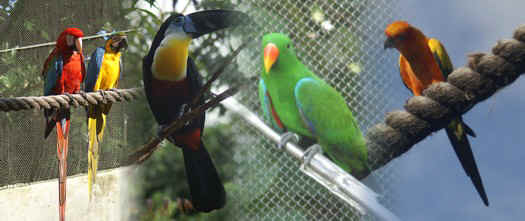
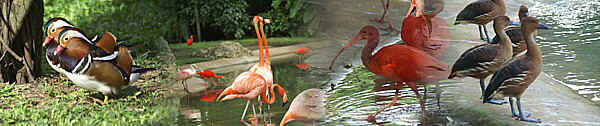
Within the sanctuary are a St Vincent Amazon Parrot exhibit and two large walk-through
Aviaries. These Aviaries replicate a Gully habitat and a Marshland Habitat and allow you
to closely observe the birds as you walk through. In the Gully Habitat Aviary can be seen
a variety of birds that include crested bobwhites, channel-billed toucans, gray
trumpeters, brown-throated parrots, eclectus parrots, sun parakeets, macaws and piping
guans. The birds seen in the Marshland Aviary include flamingoes, whistling ducks,
mandarin ducks, roseate spoonbills and scarlet ibis.
While Graeme Hall is a sanctuary for wildlife it is also a sanctuary for humans.
Strategically positioned throughout the visitor section are benches where you can sit in
solitude and observe or reflect on life. Along the boardwalk and trails are interpretive
displays that provide information about the birds, plants and animals in the sanctuary. In
visiting Graeme Hall you can walk through at your leisure or participate in a group tour
conducted by a trained naturalist. A small fee is charged for entry to the sanctuary and
this is payable at the Visitor Centre and Sanctuary Store, which has educational toys and
kits, books, souvenirs, food and drinks, and many other items.
So the next time you are in Barbados, discover the hidden Bajan paradise that is the
Graeme Hall Nature Sanctuary.
To learn more about Barbados, visit our other Barbados Pages
In the introduction to each episode of the Star Trek series, there is the phrase
"To boldly go where no man has gone before" and indeed sometimes when you are
trying to find a particular place it seems that is what you are doing. At other times you
want to go where other people have gone before and experience the history of the place. In
Barbados there is a particular place where it is very easy to view and experience the
history of this island. You can literally walk through history and on a quiet afternoon be
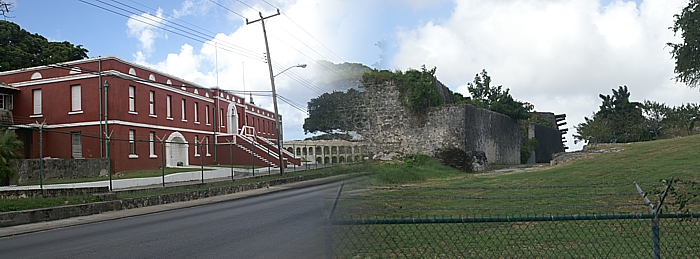
transported back in time. This location is known as the Garrison Historic Area and it
surrounds the Garrison Savannah.
The Garrison Savannah is the center of much of the sporting and recreational activity
in Barbados. The island’s horse racing track is located in the Savannah and horse
racing has been taking place since the middle of the 1800’s. There is a rugby field,
basketball court and jogging track, all of which are extensively used on afternoons. The
Savannah however is a historic location for much more than sport. On November 30th 1966,
in the Garrison Savannah, the ceremony was held for the lowering of the Union Jack
(British flag), and the raising of the Barbados flag, thus signaling full independence for
the country of Barbados. The historical significance of the Garrison Savannah goes even
further back. In 1650 Charles Fort was erected in the area and then in 1705, St.
Ann’s Fort was added. The arrival of British troops in 1780 led to the establishment
of the Garrison. From 1796, the Garrison area became the headquarters of the British West
India Regiment and the large grassy area in the center, which is now the Garrison
Savannah, was the regiment’s parade grounds. The British West India Regiment was the
first British Regiment of black soldiers, and provided 132 years of service both in the
British West Indies and worldwide. Being the site of a military complex, numerous
buildings were constructed from the 1660’s to the 1800’s. These buildings today
give the Garrison area much of its historical and architectural interest.
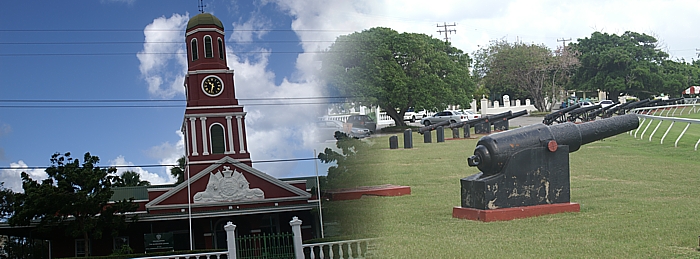
On any walk around the Garrison area you cannot miss seeing the numerous cannons that
are located in the area. These form part of the National Cannon Collection, which
constitutes the largest cluster of 17th Century English cannons in the world. Within the
Barbados National Cannon Collection is an Elizabethan cannon cast in 1600, the only one
known to exist. The Collection also contains one of only two cannons in existence from
1652 with Oliver Cromwell's crest.
Some of the cannons can be seen in front of the Main Guard building facing the
racetrack. This elegant Georgian building from 1802 with its handsome clock tower and wide
verandah is now an information centre and houses exhibits about the West Indian Regiment.
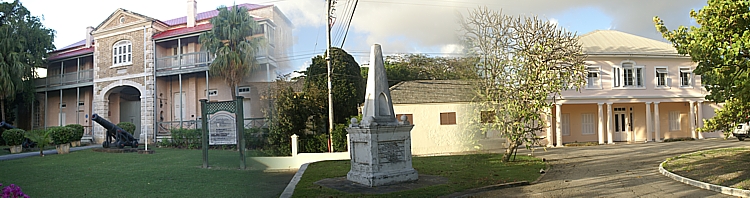
As you continue around the Savannah there are numerous 17th- to 19th-century military
buildings constructed from brick brought as ballast on ships from England. There are also
several memorials. One of the memorials commemorates the death of 15 persons and the
destruction of the barracks and hospital in a hurricane on 18 August 1831. Another
memorial outside the Barbados Museum in the northeast corner is in honour
of the men of the Royal York Rangers who fell in action against the
French in Martinique, Les Saintes and Guadeloupe in the 1809-10 campaign.
The Barbados Museum is housed in a compound that was formerly a military prison, and
centered around a large airy courtyard with trees and flowering shrubs. The museum houses
a Natural History gallery, a History Gallery with sections devoted to Amerindian
artifacts, Colonial Years, Emancipation, the period leading to Independence, two small but
very interesting sections on Education and Religion, Agriculture, Road making, Electricity
and Bajan Architecture. Each little cubicle tells a complete story with actual implements
shown and Photos from the period. There is the Warmington Gallery which is a recreation of
a house interior and where you stay from outside and look through the windows. The Africa
gallery which has a bright fresh clean look is not what you would expect. This gallery
shows some African kingdoms and shows many of the links between Africa and our Caribbean
traditions and habits. The Children Gallery is highly fascinating and even adults will
enjoy it. Some parts of this gallery take you down memory lane (depending on your age).
Completing the circle of historic buildings in the Garrison Historic district is St
Ann’s Fort which is still used by the Barbados Defence Force. Although you cannot
enter the compound you can still observe the old drill hall and other military buildings.
The outline of the original stone fort with its cannons pointing outwards cab be seen both
from the Garrison side and the nearby Drill Hall Beach. The crenellated signal tower with
its flag pole on top that formed the high command of a chain of signal posts around the
island is also visible. .
So when next you are in Barbados, visit the Garrison Historic District and be
transported back in time.
Barbados may be known for its gorgeous
beaches, but before you head out to these sandy patches of paradise, take
the time to explore the island nation's only true city -Bridgetown. This
Caribbean city and holds the biggest population in the country, and offers
curious visitors a look at Barbados' rich culture and history.
While the city may have established quite a
number of modern structures like office complexes, shopping malls and banks,
Bridgetown has still managed to preserve a number of its most precious
historic sites and colonial buildings. The city maintains a very energetic
atmosphere enhanced by its vibrant streets, regularly occupied by eager
vendors of various goods and fresh produce. Here, you will get plenty of
opportunities for duty -free shopping especially in areas like Broad Street.
It is also very easy to find local crafts in the city's street markets.
Most of the important tourist sites in
Bridgetown are within easy walking distance from the city center. And
fortunately, the city buses serve most of these destinations. Take note that
Bridgetown is one of the oldest cities in the Caribbean. While here, don't
miss the chance to walk around its fascinating historical section, which is
home to the city's most precious architectural landmarks, including the
Parliament Buildings of Barbados. These buildings exude the exquisite
neo-gothic design and were constructed in the late 19th century using coral
limestone. One of the impressive features of the buildings is its stained
glass windows, which depict the different British monarchs. Its west wing
houses the government offices, the clock tower, the Parliament Museum and
the National Gallery. And if you walk to the east wing, you will find the
Senate and House of Assembly.
The
Barbados Garrison is another
significant historical landmark in Bridgetown. It fact this garrison is
listed as a UNESCO World Heritage Site as it is considered to be the largest
of its kind during the 18th and 19th centuries. These days, the garrison
houses the Barbados Defense Force, but it has other sections that are worth
visiting. Some of these sections include the St. Ann's Fort, established in
1705; the Georgian style mansion called George Washington House; and the
Barbados National Armoury, which maintains a massive collection of iron
cannons, made during the 17th century. Another important building found in
the garrison is the Barbados Museum, which can give you great insight into
the island's history through its extensive exhibits and galleries. In the
exterior portion of the Barbados Garrison lies an oval green space, which is
used as a park and venue for sporting events, horse races and parades.
Make your way to
the city's natural harbor called Carlisle Bay, which also plays hosts to
regular water sports events. If you walk to the southern side of the bay,
you will find the popular Pebbles Beach, which is frequently visited due to
its soft white sand and perfectly calm water, suitable for swimming. If
scuba diving is something you would like to do, arrange an excursion to the
Carlisle Bay Marine Park, whose ocean floor is occupied by a couple of old
shipwrecks.
If you are
content just staying on the beach, comfortably sitting on a sun lounge and
protected by an umbrella; then you should seek out the Boatyard Beach Club.
This club is conveniently equipped with a restaurant and offers a range of
fun water-based activities.
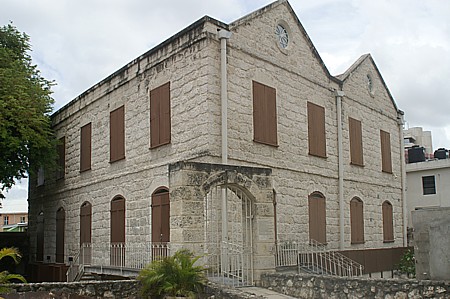
Barbados is not a location that one generally associates with Jews but yet
in Bridgetown there is the Nidhei Israel Synagogue and Nidhei Israel Museum
located appropriately on Synagogue Lane, very near the main shopping streets
of James Street and Swan Street. While one may not associate Jews with
Barbados, the island has a Jewish history that goes back to 1654, when
Sephardic Jews came as refugees from religious persecution in Dutch Brazil.
It is the arrival of these refugees that really spurred the development of
the sugarcane industry in Barbados as they brought with them their knowledge
of the cultivation and production of sugarcane.
While some of the Jews settled in Speightstown, most settled in Bridgetown
as merchants and constructed their synagogue in 1654. The cemetery that lies
just outside and almost surrounds the synagogue with its raised graves is
believed to be the oldest graveyard in the Western Hemisphere with graves
dating back to 1660. Some of the grave stones are inscribed in Hebrew,
English and Ladino, a blend of Spanish and Hebrew spoken in the Sephardic
community. The synagogue was destroyed in a hurricane in 1831 and then
rebuilt, however with outward migration of the Jewish community the building
fell into disrepair and eventually was sold in 1929. After multiple owners
the building again fell into disrepair and in 1983 it was seized by the
Barbados Government. After two years of petitioning by the small local
Jewish community, the Government turned the building over to the Barbados
National Trust.
In 1986, the renovation of the building began and eventually the building
was reconsecrated as a synagogue and called the Nidhei Israel Synagogue
which means Synagogue of the Scattered of Israel. In 2008, the Nidhei Israel
Museum was opened on the same compound. This museum depicts the history of
the Sephardic and Ashkenazi Jews in Barbados.
Almost every Caribbean child knows the story of the tortoise and the hare, however many
have never seen a tortoise and even less have seen a hare. Well at the Barbados Wildlife
Reserve you can actually see the tortoise and the hare.
This wildlife reserve is located along the route to the east coast of Barbados in
the northern parish of St Peter. It is in a natural mahogany forest across the road from
the Farley Hill National Park. Here the animals are in the open in a natural environment,
allowing you the opportunity to stroll through the reserve and observe them in their
natural habitat. There are cages for some animals, reptiles and birds but these are few
with the majority being able to roam freely. The Reserve has over 100 mammals, more than
10 different species of reptiles, and over 470 birds. Among the birds are parrots, macaws,
flamingoes, peacocks, brown pelicans and sparrows. Many of these birds are in a large
walk-through aviary allowing you to wander among them. In another section of the property
there are collections of budgerigars and love birds. Throughout the grounds, guinea fowl
wander freely. There is also a salt-water aquarium built in to the snack bar, housing an
assortment of tropical fish.
Among the animals and reptiles to be seen at the wildlife reserve are Green Monkey, Red
Brocket Deer, Cuban Iguanas and Red-footed Tortoise. The green monkeys found in Barbados
originally came from Senegal and the Gambia in West Africa approximately 350 years ago.
These are a species of the vervet monkey and it is believed that they came as pets onboard
the slave ships. About 75 generations have occurred since these monkeys arrived in
Barbados and, as a result of environmental differences and evolution, the Barbados monkeys
today have different characteristics than those in West Africa. There are now between five
thousand and seven thousand monkeys in Barbados. The top side of the fur of the vervet
monkeys varies from pale yellow through grey-green brown to dark brown, while the lower
portion and the hair ring around the face is whitish yellow. The face, hands, and feet are
hairless and black. The fur has specks of yellow and olive green, which in some lights,
give the fur an overall green appearance ... hence, the name the "Green
Monkey". The monkeys at the reserve live freely, wandering through the grounds
and in the adjoining Grenade Hall Forest plus among nearby plantations. They are
semi-arboreal and semi-terrestrial, spending most of the day on the ground feeding but
also spending time in the trees playing, feeding and grooming, and then sleeping at night
in the trees. A good time for seeing these monkeys is at 2pm daily when food is laid out
in the reserve and the troop converges at the feeding trays. There are however a few
monkeys kept in cages so that visitors can be assured of seeing them.
Brocket Deer are a group of deer species of the Mazama genus found in South
America and the Yucatán Peninsula. They are small in size and dwell primarily in forests.
They have small rounded bodies, ranging from 70 to 140 cm in length, and usually have a
light or dark brown coloration. Weight ranges from 8 to 30 kg. The antlers are short and
are shed very infrequently. The species seen at the Barbados Wild Life Reserve are the Red
Brocket (M. americana) which is the largest species of Brocket Deer, weighing up to
30 kg. It has a reddish-brown coat.
The opening hours for the reserve are 10:00 a.m. – 5:00 p.m. daily with the last
admission at 4:00 p.m. A refreshment bar is open daily and a restaurant/snack bar is open
Tuesday to Thursday. Your entrance fee to the Barbados Wildlife Reserve also gives you
admission to the adjoining Grenade Hall Forest and Signal Station which are within walking
distance of the reserve.
Within the Grenade Hall Forest there is a pathway that winds down a slight incline and
through the forest. The path allows visitors to explore the diversity of trees and plants
and throughout there are signs that explain the origins and medicinal properties. As you
wander along the green monkeys may be seen moving overhead on the branches. If at the
conclusion of your walk you are in need of refreshment, there is a snack bar at the
entrance to the forest and benches for your rest before you proceed to the signal station.
The Grenade Hall signal station was originally constructed in 1819 as one of a group of
signal stations used for communication across the island. These towers were constructed in
strategic locations around the island on high ground and that now provides amazing views
making them the perfect vantage points for appreciating the natural beauty of the island.
In addition to the view however the Grenade Hall signal station provides a brief history
of the military units that were stationed in Barbados.
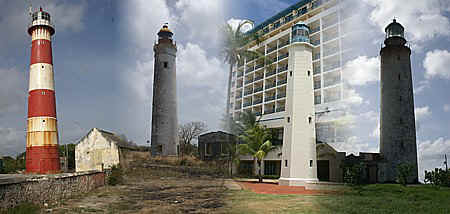
Barbados has four lighthouses, literally on the four corners of the island and they are
an interesting addition to the places to visit in Barbados. Each of these lighthouses is
fairly easy to get to and each provides a magnificent view.
Harrison Point Lighthouse has been in existence since 1925 and is located at Harrison
Point the most north-westerly point of Barbados in the parish of St Lucy, about 8 km (5
mi) north of Speightstown. The lighthouse rises to a height of 193 feet (59m) and stands
alone on the edge of a flat plain overlooking the blue Caribbean Sea. Looking inland you
see the sugar cane fields and then in the distance the land rises in a line of low hills.
The road as you get close to the lighthouse has been worn with age and in parts the scrub
has grown tall on the sides of the road but the road is still navigable. Close to the
Harrison Point lighthouse is a compound that has gone through several uses. It has been
used as temporary housing for the prison inmates who burnt down the Glendairy prison, as a
base for the Barbados Youth Service and as a Police training facility. The original use of
this compound however was as a United States Naval Facility. Commissioned on 1 October
1957, with a complement of about 12 officers and about 88 enlisted personnel the Naval
Facility (NAVFAC) Barbados was operated by the United States Navy for twenty-two years and
was officially decommissioned on 31 March 1979. On 6 July 1962, NAVFAC Barbados made the
first detection of a Soviet Nuclear submarine as it crossed over the
Greenland-Iceland-United Kingdom (GIUK) gap.
Needham's Point Lighthouse is located at the south end of Carlisle Bay, southwest of the
capital, Bridgetown. Built in 1855, this lighthouse is 13 m (43 ft) in height with an
octagonal masonry tower with a lantern and gallery. Needham's Point Lighthouse is probably
the easiest lighthouse in Barbados to visit as it is on the grounds of the Hilton Hotel
directly on the beach front. The hotel has restored the lighthouse and painted its
exterior.
South Point Lighthouse was the first lighthouse to be constructed in Barbados. In 1851
this lighthouse was exhibited at Londons Great Exhibition, then taken apart and
transported to Barbados where it was reassembled and installed in 1852. South Point
Lighthouse rises to a height of 189 feet and is a landmark, with its red and white
horizontal bands, that is easily spotted from many points along the south coast of the
island. Located in the residential district of Atlantic Shores, just to the east of Miami
Beach in Oistins.
The East Point Lighthouse is located at Ragged Point which is about 2 km (1.2 miles)
northwest of East Point, the easternmost point of Barbados. Built in 1875 to a height of
213 feet (65 meters) it is situated on a bluff overlooking the Atlantic ocean. From the
grounds around the East Point lighthouse there is a magnificent view of the Atlantic ocean
and the cliffs of the east coast.
One of the nice aspects of Barbados lighthouses is that it is easy to combine a visit to
the South Point and Ragged Point lighthouses, in fact you can visit all four in one day.
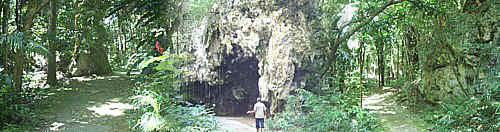
Welchman Hall Gully is one of the interesting attractions in Barbados and provides an
opportunity to take a walk through nature while learning about the flora and geology of
Barbados. Welchman Hall Gully was once part of a plantation owned by a Welshman called
General William Asygell Williams over 200 years ago. Hence the name Welchman Hall gully.
It was General Williams who first developed the gully with exotic trees and an orchard. In
1962, the Barbados National Trust bought the gully as their first property purchase.
Welchman Hall Gully is located 885 feet (270 meters) above sea level and is 3/4 mile long,
divided into 6 sections. The walkway through the gully is paved and shaded by the many
trees that grow in the area. There is a small fee for entry into the gully and a guidebook
can be purchased at the entrance that highlights over 50 plants and features in the gully.
As you walk through the area you will observe that there are signs on many of the trees
making them easy to identify and the guidebook has good descriptions of the plants and
their uses. One section in the gully is called Nutmeg Walk and is the only nutmeg grove is
Barbados with many of the trees believed to be over 100 years old. The Gully has specimens
of the three species of palms that are native to Barbados plus other palms that were
introduced to the island.
Welchman Hall Gully is believed
to have originally been an underground cave and the roof of the cave collapsed creating
the gully. It is thought to have once been part of the Harrison's Cave complex before the
roof collapse. While strolling through the gully you can still see many interesting
stalactites and stalagmites. Two troupes of Green Monkeys inhabit the area around the
gully and at feeding time descend to a feeding station that has been created so that
visitors can view them.
Welchman Hall Gully is located near the centre of Barbados, in the parish of St. Thomas
and is a ten-minute drive along Highway 2 going north from Everton Weeks Roundabout
located on the ABC Highway in Warrens. Once on Highway 2 it is fairly easy to find the
Gully as you simply have to follow the signs along the road pointing to either Harrison's
Cave or Welchman Hall Gully as the gully is close to Harrison's Cave. This route will
bring you to the southern end of the gully.
Going to the
Springvale Eco-Heritage Museum is another of the interesting drives in
Barbados. If you are coming from the South Coast you start off on the ABC
Highway and this is what most people know as a Highway; two lanes with
traffic headed in one direction separated from the traffic headed in the
opposite direction. Then you get to Warrens and turn on to Highway Two. Why
anyone would classify this road as a Highway is hard to imagine. Highway Two
is a single lane country road that runs through small villages. While the
road is definitely not a highway the drive is pleasant; small villages,
rolling countryside, views across open fields and you go past several of
Barbados visitor attractions so that you can combine your visit to the
Eco-Heritage Museum with stops at other sites.
Along the way to the Springvale Eco-Heritage museum there are numerous
directional signs pointing to the museum and these are very helpful because
Highway Two has many side roads that join it and it is very difficult to
tell which is the side road and which is the highway. If at any point you
are unsure of the route and do not see the signs to the museum you can
follow the signs to Harrison’s Cave or
Welchman Hall Gully (until of course you go past those attractions). The
museum is located on a section of the road that runs downhill and it is set
back from the road plus surrounded by trees so it is very easy to miss the
entrance.
This
museum is largely the work of one man, Newlands George, who created it when
he retired from running Springvale Plantation. The museum is housed in a
former plantation manager’s house and the heritage aspect of the museum is
derived from the fact that this attraction is devoted to the customs
practiced by Barbadians in the past. As a result there are figurines with
the tools that they used and the products that they made, such as the
laundress, the basket weaver, the potter and the coral stone builder. There
are other aspects of historical Barbadian life in the collection of old-time
cooking pots and furniture plus a small library with old books.
The Eco aspect of
the museum comes about because the Springvale area is a lush forested part
of Barbados. The museum has a short walking trail that visitors can wander
along passing by coconut, breadfruit, banana and other tropical fruit trees
plus vegetables and medicinal herbs. The nature trail leads to a small
stream that is shaded by bamboo.
There is a small café serving snacks and drinks and on the same property is
also an artist’s gallery. The Springvale Eco-Heritage Museum is open Monday
to Saturday from 10:00 a.m. to 3:00 p.m. For Sunday viewing appointments
have to be made.
Barbados with its crystal clear water is a great place for both snorkeling
and Scuba diving. There are
natural barrier and fringe reefs which provide the ideal environment for a
very diverse group of marine life. The reefs are found mainly off Barbados
west and south coast and they are flourishing with healthy sponges, coral
and plant life. The barrier reefs, located 1/2 - 2 miles from shore feature
some large coral heads which form the habitat for thousands of beautiful
fish and are perfect for snorkeling. The Hawksbill turtle can also be found
on these reefs. The fringe and patching reefs are located closer to shore
and have smaller coral formations but more abundant plant life then the
barrier reefs. These reefs are home to Sea Horses, Frog Fish, Giant Sand
Eels and many other marine creatures.
There are three designated snorkeling areas in Barbados with two of them
located on the west coast in the Folkstone Marine Park and the third on the
south coast in the Carlisle Bay Marine Park.
The Folkstone Marine reserve was established in 1981 for the promotion of
science. This reserve consist of a Scientific Zone, Northern Water sports
Zone which facilitates water skiing, jet skiing, para-sailing etc, a
Recreational Zone which facilitates snorkeling, fishing, swimming etc and a
Southern Water sports Zone which like the Northern zone also facilitates
water skiing, jet skiing, para-sailing. You will find that the inshore reef
found in the Recreational Zone of the Park is ideal for snorkeling. Also of
benefit is its close proximity to the shore. It is located about one-third
of a mile offshore. This reef is home to schools of brightly colored fish
and other marine life, including sea anemones, sea lilies, corals and
sponges.
The second designated snorkeling area is also located in the recreational
zone at the Folkstone Marine Reserve, a little way from the beach at
Holetown. There is an artificial reef in this second area which was created
from a barge that has been sunk in the reserve. This area attracts a wide
variety of marine life such as chubs, snappers and squirrelfish.
The third designated snorkeling area in Barbados is located at the Carlisle
Bay Marine Park on the south coast. In this reserve there are no natural
reefs but you will find a number of shipwrecks, swarming with a plethora of
beautiful tropical fish including Frog Fish and Sea Horses and other more
common reef fish.
For the scuba diving enthusiast, apart from the reefs there are numerous
sunken ships to explore. A popular reef dive site on the west coast of
Barbados is Dottins Reef near Holetown. The site is characterized by huge
coral reefs that attract bright and colorful fish that aren't particularly
afraid of people. The Dottins Reef offers a dive of 40 to 60 feet. Another
reef dive site on the west coast is Little Sandy Lane, located just off
Sandy Lane. This reef is frequented by Barracuda and other smaller tropical
fish. There's also a possibility of seeing lobsters on the reef but they
have a tendency to camouflage themselves between the cracks. This reef
offers a diving depth of 90ft.
Maycocks Bay on the northwest coast of Barbados features several coral reefs
separated by large stretches of white sand; divers can see about 100 feet or
more down these natural underwater halls. Also on the west coast is the 365
foot Greek freigher, Stravronikita, that was deliberately sunk in 1978 to
form an artificial reef and this wreck is now home to numerous fish and
corals. The Stavronikita lies in 120ft of water with the stern at 100ft and
the bow at 70ft.
On
the southwestern coast of Barbados is Carlisle Bay, which is a natural
harbor that has been turned into a marine park. Carlisle Bay is great for
wreck diving with four wrecks of particular interest being the Berwyn, Eilon,
C-Trek and Fox. In 2002 the Bajan Queen was sunk to add a fifth wreck.
At Carlisle Bay you can find relics from ships including cannonballs,
cannons and anchors.
Bell Buoy on the south coast off Accra Beach, is a coral reef formed in the
shape of a dome with brown coral tree forests, and is home to a large number
of fish including angel fish, chromis, and parrot fish. This reef offers
diving between 20 feet to 60 feet. When married with the natural bright
sunlight, its shallow depth makes it an enviable place for photography.
Silver Bank on the south coast off Brighton Beach is located in 60 to 80
feet of water and offers an abundance of tropical fish, Sea fans and
beautiful coral formations.
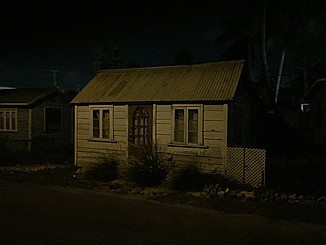
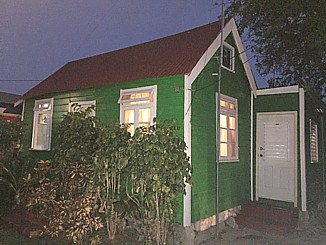
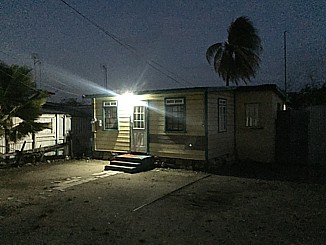
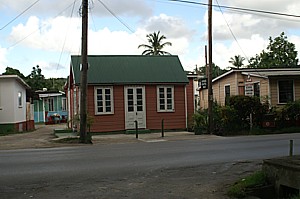
Cute is the word that describes them and they are found everywhere in
Barbados; the chattel house. These small wooden houses are representative of
a time when the Barbadian economy was dominated by agriculture and the land
owners had all the economic power. The versatility of these homes however
has allowed them to endure.
A
chattel house is a small moveable wooden house that the working classes of
Barbados would live in, reflective of today's "tiny houses" in the U.S. In
the days of the large plantations workers did not own land and knew that in
the event of any dispute with their employer they could be thrown off the
land on which they resided. Thus they erected small wooden houses that could
be moved from one location to another. They were built without nails to
allow easy disassembly and placed on large stones or blocks.
The roofs were usually steep gable roofs to allow the rain water to quickly
run off and also the steep angle deflected the wind rather than allowing the
wind to get under the roof and lift it off.
These houses often started out as one rectangular building but over time
additions would be made to the home as economic circumstances allowed. So
today when one looks at a chattel house you sometimes see multiple roofs or
sections of the house at slightly different heights or sections with a
different pattern.
As
to where the name came from, well the word "chattel" means moveable property
and the house was the moveable property of the worker, hence chattel house.
Dover Beach is on the south coast of Barbados at the eastern end of St Lawrence
Gap. The Gap as it is simply called is an entertainment hot spot that comes
alive at night. There are Bars, restaurants, roadside food stalls, hotels
and convenience stores. Lower down the Gap is the quieter side of St
Lawrence Gap. There are still bars along this eastern side but they are
interspersed among hotels, condominiums and other businesses and these bars
tend to have smaller less noisy crowds. The quieter side begins at the
football field opposite which is a public beach facility. At the beach there
are water sports, beach chair rentals, toilets, showers, concessionaires
selling drinks, snacks and food.
Dover beach has that white powdery sand that Barbados is famous for and that
aquamarine clear ocean. Throughout the day there are persons at this beach
from early in the morning with those taking a quick morning dip before
heading out to work and old men taking their morning stroll along the beach
before soaking their limbs in the refreshing water to late evening with
those taking a last swim before the sun sets. At night this lower end does
not have the frenetic pace of the upper end but you can still find a spot
for a drink or a bite to eat.
Within the public beach facility at Dover Beach are several concessionaires
and one of these is known simply as Johnny's. Johnny's on a Friday and
Saturday night provides a refreshing change to the pounding loud music
usually found at many nighttime establishments. Johnny's is the last
concessionaire on the eastern end of the beach facility. Set apart from the
other concessionaires with the area in front shaded by two large almond
trees and a wooden decking providing ease for the feet from the hot sand,
Johnny's is a comfortable place to have a drink during the day or a
delicious meal of grilled food. On most days Johnny opens by 10 am and
closes at 6pm, however Friday and Saturday night are different and special.
On Friday and Saturday nights Johnny serves up a delicious fare of live jazz
and rhythm and blues. The twinkling lights, the lighted torches with the
ocean for a backdrop and moonlight filtering through the trees creates a
perfect setting for relaxing and letting the music flow through your soul.
Beginning at 8.30pm and continuing until shortly after 11pm, the music plays
and drinks can be had. With the chairs and tables spread among the
deck there is a joie de vive among the audience.
The most abundant form of wild life in Barbados is the Green Monkey. These monkeys
originally came from Senegal and the Gambia in West Africa approximately 350 years ago.
They are a species of the vervet monkey and it is believed that they came as pets onboard
the slave ships and some escaped into the wild. About 75 generations have occurred since
these monkeys arrived in Barbados and, as a result of environmental differences and
evolution, the Barbados monkeys today have different characteristics than those in West
Africa. There are now between five thousand and seven thousand Green Monkeys in Barbados.
The name Green Monkey comes from the physical appearance of the monkey. The top side of
the fur of the vervet monkeys varies from pale yellow through grey-green brown to dark
brown, while the lower portion and the hair ring around the face is whitish yellow. The
face, hands, and feet are hairless and black. The fur has specks of yellow and olive
green, which in some lights, give the fur an overall green appearance ... hence, the name
the "Green Monkey".
The Green Monkey is semi-arboreal and semi-terrestrial, spending most of the day on the
ground feeding but also spending time in the trees playing, feeding and grooming, and then
sleeping at night in the trees. These monkeys live in family troupes with the parents and
the young. The females are quite maternal, carrying their young on their bellies or chest,
constantly covered by one protecting arm. They are somewhat shy and retreat if you get too
close. At times they have arguments among themselves and then you can hear them crashing
through the trees as they chase each other from branch to branch
These monkeys are indeed the most abundant form of wildlife in Barbados and can be seen
wandering through the backyards of many homes, especially if there are fruit bearing trees
in those yards. They are especially attracted to Mango, Almond and Banana trees. These
monkeys are also seen along the coast near some hotels if the area has many fruit trees.
On the south coast you can see them at the Graeme Hall Nature Sanctuary in
the trees at the entrance. One of the best places for seeing these monkeys is the Barbados Nature Reserve. The
monkeys at the Nature Reserve live freely, wandering through the grounds and in the
adjoining Grenade Hall Forest plus among nearby plantations. A good time for seeing these
monkeys is at 2 pm daily when food is laid out in the Nature Reserve and the troop
converges at the feeding trays. There are however a few monkeys kept in cages so that
visitors can be assured of seeing them. Another good location for seeing these monkeys is
at Welchman Hall Gully during the morning and evening
feeding times.
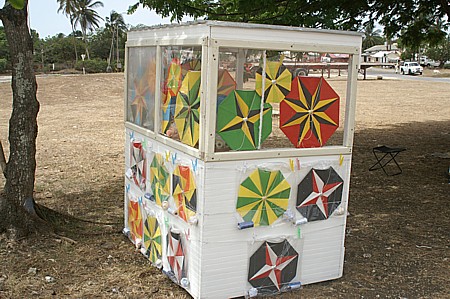
Easter is kite flying time in Barbados, everywhere you
look there are kites flying in the sky. While the manufactured kites in
shapes of birds, dinosaurs and dragons are seen, the traditional Bajan kite
still rules the skies. The traditional Bajan Kite is a hexagonal shaped kite
that is known in other islands as a
Mad Bull. These very colourful kites are sold everywhere; every street
corner has a stand selling these kites. Kite packages come complete with
tails and string, so you just purchase, look for an open area with a strong
wind and fly.
All through the Easter school holidays children can be
seen flying kites but Easter Monday is the high point when the skies above
Barbados are filled with kites. There are kite flying competitions, with two
of the best known being at the UWI Cave Hill campus and at the Garrison
Savannah. Although these two are the best known, there are competitions
everywhere from St Lucy down to Oistins. Every cricket field and open area
is filled with people flying kites. Some of the competitions are organised
by Sports and Cultural Clubs in the various areas. In some areas there is
music and Barb-B-Q cooking on the side while grandmothers sit in the shade
and watch the children. Even in areas where there are no competitions the
skies are adorned with kites. Very often it is mothers and fathers showing
their young ones how to master the art and at the same time reliving their
youth.
So if you are in Barbados during Easter either
make your own kite or stop by a stall and buy one then take to the air.
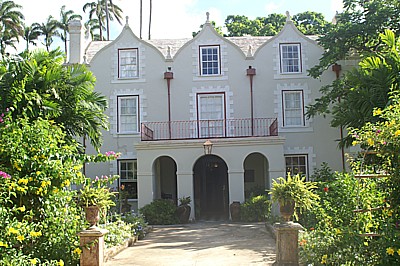
One of the most striking features about St Nicholas
Abbey is the area around the roadway and entrance to the plantation. A
profusion of mahogany trees and cabbage palms surround the road enveloping
you in coolness and shade and the chirping of numerous birds. Many of these
trees would have been planted in the mid 1700's by Sir John Gay Alleyne, one
of the previous owners. St Nicholas Abbey is a functioning sugar plantation
that produces sugar and a unique light sipping rum. Visiting St Nicholas
Abbey is however much more than simply seeing fields of sugar cane, it is
being transported back in time and also learning the fascinating process of
making rum.
The St Nicholas Abbey plantation came into being in the 1600's and initially
it was actually two separate plantations owned by two business partners.
Benjamin Berringer owned a plantation known as Berringer's Plantation and in
1658 he built the Jacobean mansion that exists today on the property. John
Yeaman owned the adjoining property known as Greenland. It is said that
Yeaman constantly lusted after Berringer's wife and in 1661 as a result of
an argument with his wife, Berringer moved to the town of Speightstown.
Within weeks of the move, Berringer was dead of suspected poisoning and
Yeaman had married Berringer's wife Margaret. With that marriage the present
property of 365 acres became one under the name Yeaman's Plantation.
Eventually the property was inherited by Margaret's grand-daughter who
refused to keep the property in the name of the man who she believed had
murdered her grandfather so the name was changed to Nicholas Plantation.
The original house from 1658 still exist and visitors to St Nicholas Abbey
are able to walk through the house and see the antiques that date from the
1800's including the Wedgewood tea sets, English Coalport China, Minton
China, Chippendale staircase and furniture from the 1800's. Also in the
house are souvenirs from the 1800s and portraits of several of the previous
owners. Adjoining the Great House is a small museum with Amerindian
artifacts and other historic documents linked to the plantation. In the
courtyard between the Great House and the Museum are the original bathhouse
and outdoor toilets plus a 400 year old Sandbox Tree.
As fascinating as the historic plantation house is, St Nicholas Abbey is a
rum producing operation and for alcohol connoisseurs the rum production is
the highlight of a visit to this historic property. The Abbey crushes its
canes the old fashioned way using a steam mill. The original mill was
installed in 1890 but the present mill was purchased in 1983 and then
restored in 2006. The steam mill is used to crush sugar cane from December
to May. After crushing the cane juice is converted into syrup and then fed
into the Distillery. On the property in the distillery is a traditional pot
still and rectifying column with its copper vessels that is used to convert
the cane syrup into the light sipping rum. During a visit to St Nicholas
Abbey you can also see the rum aging in bourbon barrels.
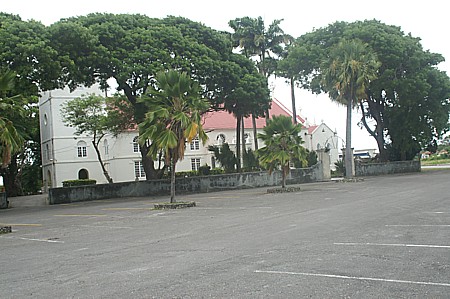
As one drives around Barbados, you are struck by the
proliferation of churches and the grandeur of some of the churches. Many of
the larger buildings are Anglican churches and this is understandable as the
Anglican Church was the first official religion in Barbados. In an 1871
survey it was reported that 90% of the population was Anglican, today this
percentage has declined to 33% but the impressive Anglican churches that
were constructed over the years have remained. However the Anglican Church
is not the only denomination that has impressive churches in Barbados.
St Lucy Parish Church
The St Lucy Parish Church sits surrounded firstly by a
huge car parking area and then by a cemetery that reaches up to the walls of
the church with many trees shading the graves. Wandering through the grounds
of the cemetery reveals that this church has been in existence for
centuries.
St. Lucy is one of the six
parishes created by Governor Sir William Tufton and the first Church
was built of wood in 1627 but destroyed in a hurricane.
The second Church was built in 1741 of sawn stone
but was also destroyed in a hurricane in 1780. The third Church was again
destroyed by hurricane in 1831. The present church which is the fourth
built on this site was constructed in 1837 in the Georgian style that is
seen throughout Barbados. The characteristic tower dominates the front of
the church.
St James Parish Church
The St James Parish Church is adjacent to the
Folkestone Marine Park. This marine park on the west coast of Barbados is
the scene of many picnics on Holiday weekends when Barbadians gather to
relax, eat and enjoy the company of each other. The park has numerous picnic
tables scattered under the large trees that dot the grounds. The beach has
the typical clear blue sheltered water found on the west coast of Barbados.
That sheltered water is due to a reef which lies a short distance off shore
and a visit to Folkestone can easily include a snorkeling swim as snorkel
equipment is available for rental at the beach. Either before or after your
swim you can easily visit the St James Parish Church as the church grounds
border the park so you can simply walk onto the church grounds.
The St James Parish Church is believed to be the first
church erected in Barbados. English settlers arrived in Barbados in 1627 at
Holetown and in 1628 a wooden church was built at this site which is close
to Holetown. A hurricane in August 1675 destroyed the wooden structure and
so in the 1690’s a stone building was constructed. This building lasted for
almost 200 years and then in 1874 reconstruction work was done which
resulted in the present building.
One of the attractive features of this church is its
stained glass windows. In one window the ascension of Christ into heaven
before his disciples is displayed with the disciples clustered around below
Christ while the kingdom of heaven opens above His head. Another window
represents 'The Baptism of the Ethopian, by St. Philip' with the two figures
surrounded by lush landscape in the form of the seaside, palm trees and
vegetation. A third window is a more modern theme displaying a garden's
colour: the many splendored hues of tropical blooms, open sky and various
greens and browns of the foliage, branches and the earth intermingled with
water.
There is a popular legend
attached to St. James' Church, that a gate in the north wall surrounding the
churchyard, referred to as 'The Devil's Gate' is opened about one hour
before service. When the bell is rung the Devil leaves the church by this
gate, and it is closed as the service is about to begin, so that the Devil
is excluded from the area. This must have been derived from the old belief
that church bells were rung to drive the devil out of the building.
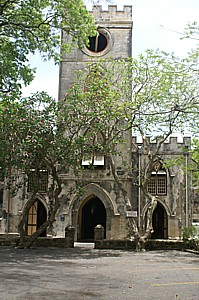
St John Parish Church
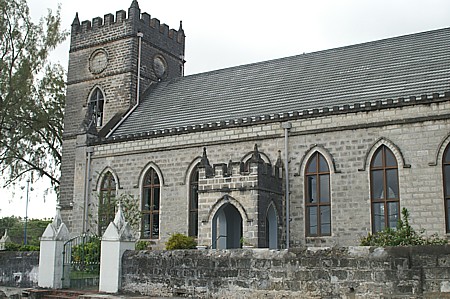
The St John’s Parish Church is at a dramatic location
being on the edge of a cliff with a fantastic view of the east coast of
Barbados. The architecture differs from many of the other Anglican churches
in Barbados in that its design is Gothic rather than Georgian. The first
church building was a wooden structure that was destroyed by fire in 1676
and replaced with a stone structure. Unfortunately hurricanes in 1780 and
1831 destroyed successive buildings until the current church was constructed
in 1836.
The church building is open to the public from 9am to
5pm each day. Apart from the beauty of the overall structure some of the
notable features of St John’s Parish Church are the
reddish-brown pulpit that was hand
carved from Ebony, Locust, Barbados Mahogany, Manchineel, Oak and Pine, that
the floor of the church is paved with ancient memorial tablets, which were
saved from earlier versions of the building, and a Madonna and Child
sculpture by Richard Westmacott that stands to the left of the main
entrance.
On the grounds of the church is a small outlet where
booklets on the history of the church plus snacks can be purchased and there
are benches where you can relax and enjoy the serenity of the surroundings.
The cemetery is filled with many old tombs that include a descendant of
Constantine the Emperor and the late Prime Minister of Barbados, Hon David
John Howard Thompson
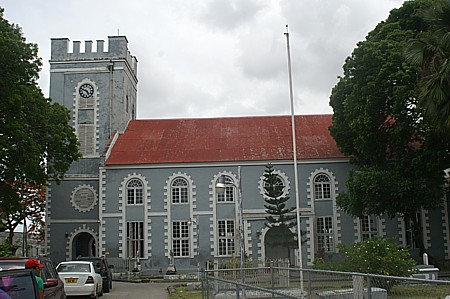
St Mary’s
St Mary’s Church is located in Bridgetown the capital
of Barbados, at the intersection of Fontabelle and Cumberland Street, near
to the Cheapside Public Market. Built in the Georgian style common in
Barbados, this is one of the oldest and finest churches in the island.
The church was built in 1825 on the site of the original St Michael’s
Church. It was consecrated by Bishop William Hart
Coleridge on July 27, 1827. Built entirely of brick, it was one of
the few to survive the Great Hurricane of 1831. Outstanding features include
the charming, jalousied south porch, the elaborate font, and the decorated,
barrel-vaulted ceiling.
James Street Methodist Church
One church that breaks the pattern of the grand
churches being Anglican is the Hanover Methodist Church on James Street in
Bridgetown. The first Methodists in Barbados came in 1789 but the sugar
planters thought that they were anti-slavery and persecuted the church. This
persecution reached a high point in 1823 when the Methodist Chapel on James
Street was demolished and burnt. Fortunately for us today, that chapel was
rebuilt in 1848.
James Street is a busy shopping street in Bridgetown
with small boutiques and many vendors sitting on the pavement with their
wares on display. The area can be very hectic especially on a Saturday
morning, however the James Street Methodist Church sits back from the
pavement with an aura of calm in the midst of the shopping hubbub. The
building is essentially a Georgian building with a Palladian port of three
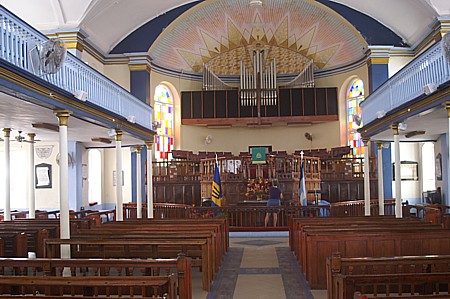
arches, pedimented front and rose window. While the exterior is attractive
it is the interior that captivates the eye. While we can seek to describe
with words we prefer to let each reader see the beauty with the photo below.
Interred at the James Street Methodist Church is the
body of Sarah Ann Gill, Barbados first female national hero. Sarah Ann Gill
was born in February 1795 to a black mother and a white father (Gill), and
baptized with the name Ann. Because of her black mother and the racism
prevalent in Barbados at the time she was not allowed to participate in the
social and economic life of the society. Sarah married Alexander George
Gill, like her, of mixed ancestry, and inherited property from him at his
death when she was 28 years old. When the Methodist Church sent missionaries
to Barbados early in the 19th century, Sarah embraced this faith and when
white planters succeeded in ousting the missionaries from Barbados, she
opened her home as a church and kept the faith going, against physical abuse
— at one time shots were fired at her home. She donated the land on which
the James Street Church, the first Methodist Church, was built in Barbados.
For her exploits in standing firm against oppression in a society in which
she was unlikely to find support firstly, as a non-white person, and,
secondly, as a woman; she was named as a national heroine. The name Sarah
was conferred on her by the Methodist Church in gratitude for her service
and in recognition of the pivotal role she played, like Sarah of the Bible.
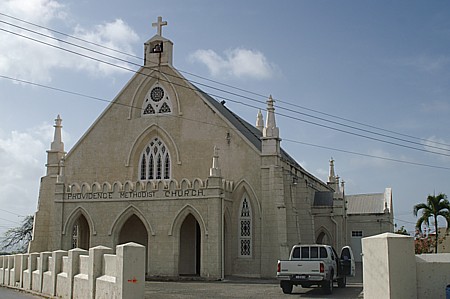
Providence Methodist Church
Providence Methodist Church located in the village of
Providence in the parish of Christ Church, is another of the many examples
of beautiful church architecture found throughout Barbados.
St Phillip Church
The St Phillip Church is located just
off Hwy 4B in Cottage Vale, in the parish of St Phillip and opens every day
from 8 a.m. to 1 p.m. The first church was damaged by a hurricane in 1780
and rebuilt in 1786 but that building was destroyed in a hurricane in 1831.
A new church was built in 1836 but damaged by fire in 1977. The building was
restored in 1979 and stands today in the midst of a grove of Mahogany trees.
The sweeping view of the east coast of Barbados makes Codrington College one
of the places to visit in Barbados, if only for the view as it offers one of
the most spectacular views of the East Coast of Barbados. This is a
theological college built in the 1700’s and in keeping with its mission it
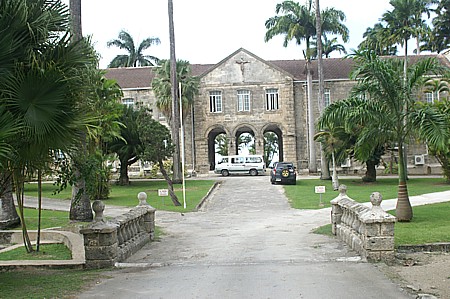
is a very tranquil setting that is soothing for the soul. The entrance to
the College is very dramatic with the driveway being lined with majestic
cabbage palms and facing the main building. As part of the grounds, there is
an extensive lily pond and nature path that is very relaxing to stroll
along.
Codrington College is the oldest Anglican theological college in the Western
Hemisphere having been built in 1743 after Christopher Codrington had
bequeathed his estate and considerable money at his death in 1710. According
to the College's web site "Christopher Codrington III (1668-1710), the
benefactor after whom Codrington College is named, was the son of a very
prominent Barbadian, Christopher Codrington II, who was at one time Governor
General of the Leeward Islands. He spent most of his boyhood at Consetts,
the site of the present College. After joining his father in Antigua for a
short while, Christopher Codrington III went to England where he took a
degree at Oxford University. He served in the Army for sometime before
returning to the Leeward Islands to succeed his father as Governor General.
His policy of amelioration of the poor whites and slaves brought him into
disfavor of the plantocracy. Consequently, he gave up the position of
Governor and returned to Barbados to live in retirement at Consetts in St.
John. In his will he had left to the Society for the Propagation of the
Gospel the estates at Society and Consetts. One of the purposes of the
bequest was that there should be maintained a number of professors who
should be obliged to teach medicine, surgery and divinity".
The College was designed by Colonel Christian Lilly, a famous English
architect, who began the design in 1713 and completed them two years later.
The construction started immediately upon completion of the designs but was
not completed until 1743 and in 1745 Codrington College opened as a grammar
school with 17 pupils. In 1830 the college became a university level
institution.
In Barbados, cricket is almost a religion, which is not surprising
considering the number of world famous cricketers that were born and
nurtured in Barbados. Given the importance that cricket has played and
continues to play in the psyche of Barbados, the island has created a museum
that is dedicated to cricket and is located at Herbert House, Fontabelle, St
Michael, the home of the Cricket Legends of Barbados Inc. The museum is
close to Barbados’ home of cricket, Kensington Oval and also close to the
Sea Port, and offers information to cricket fans and visitors alike who are
interested in the history and heritage of Barbados cricket.
The Cricket Legends of Barbados Museum is filled with nostalgic photos and
priceless memorabilia of some of the greatest players in the history of
cricket, with some of the memorabilia dating back to the early 1900s. As one
enters the museum, they are greeted by pictures of the many legends of
cricket, with eight of those members on the wall considered icons for their
sterling and outstanding performances throughout the years. These Icons are
Sir Garfield Sobers, Sir Everton Weekes, Reverend Wes Hall, Charlie
Griffith, Seymour Nurse, Gordon Greenidge, Desmond Haynes and Joel Garner.
Under each portrait is their statistics and a brief biography.
In the Heritage Room, there are exhibits dating back to 1895 and one will
learn about the early masters of Barbados cricket. The Icons Room has
collections from Desmond Haynes and Gordon Greenidge, the game’s most
notable opening pair. There is also a display dedicated to Sir Garfield
Sobers, the game’s greatest all-rounder. There is a Press Gallery where old
newspaper clippings commemorate the contribution of the media to the
development and promotion of cricket. The Cellars depict different aspects
and historical moments such as new Kensington Oval, old Kensington Oval and
Sabina Park.
The museum is open from Monday to Friday at 9:30 a.m. to 5 p.m. and on
Saturday at 9:30 a.m. to 3 p.m. Special opening hours usually apply when
international matches are being played at the nearby Kensington Oval. In
addition to the museum there is also a gift shop and The Pavilion Bar and
Restaurant. The gift shop offers a range of West Indies apparel as well as
Cricket Legends branded wear for men, women, children and babies. There are
T-shirts, polo shirts, autographed miniature bats, autographed cricket balls,
books, games, prints and more.
“Strong or not too strong?” asked the barman, smiling wildly and clutching a
large bottle of rum. I weighed up my options and decided to err on the side
of caution. The night, after all, was young.
“Sorry, you’ve come to the wrong place,” he laughed, handing me a glass of
rum punch that was significantly more rum than punch. I took a sip of the
potent brew, winced slightly, then took another as my feet began to tap to
the calypso beat.
Welcome to Oistins - Barbados’s wildest night out. Every Friday evening,
this fishing village on the south shore bursts into life with locals and
visitors arriving in search of finely-cooked fresh fish and strong rum. Music
plays, people dance and the smells of sizzling swordfish steaks and barbecued
blue marlin fill the balmy air.
Oistins is strictly a no-frills affair. Dozens of rustic outdoor stalls
stand just a stone’s throw from the beach where waves gently lap against old
wooden fishing boats.
But
what Oistins lacks in finesse, it makes up for with sheer sensory overload.
The mood was jovial, electric and infectious. Smiling people strolled around
armed with bottles of Banks beers and glasses of tropical-coloured
cocktails; the night was alive with the sounds of reggae and singing. Smoke
spiralled into the dark and starless sky while flashes of flames sparked
brightly from nearby grills stationed by dancing chefs.
Blackboard menus made for mouth-watering reading with everything from kingfish
to mahi -mahi and plenty for non-seafood fans, making choosing where to eat
an impossible task. Pausing briefly to browse some of the handicraft stands I
eventually settled on Uncle George’s – a spot favoured by native foodies.
Crowds had gathered in great numbers outside the small concrete hut. The
snaking queue vanished out of sight while the chef frantically replenished
peachy-pink shrimps on the giant barbecue illuminated by bare light bulbs.
After queueing and for about £7, I was handed a hearty portion of tender
marlin, giant chargrilled potato wedges with salad and spicy mayo all served
in a polystyrene container. I did say it was no-frills.
I
devoured my feast on one of the wooden picnic tables as the crowd outside
Uncle George’s continued to swell, hungry punters drawn by the appealing
aromas of fried flying fish with breadfruit mash, to be washed down with a
murky-looking drink called mauby, made from tree bark.
But
there’s more to Oistins than its weekly fish fry that lasts into the early
hours. Named after a wealthy English settler named Austin, the small
community played a pivotal role in the nation’s history.
It
was here in the 17th century that a battle broke out between Royalists and
Cromwell’s Roundheads that later resulted in the formation of the Barbadian
Parliament.
Lexie’s, just next door to Uncle George’s, was in full swing as I savoured
the last morsel of marlin. Another Oistins institution and one of 1,600 rum
shops on the island, this simple drinking hole painted in forest green is
the place to go to throw some shapes whether you want to foxtrot or
body-pop.
During the week, Lexie’s is the stomping ground of fishermen often overheard
putting the world to rights as ballroom aficionados waltz across the dancefloor
to the sounds of the 1950s. Come the weekend, however, things get wild.
Standing outside under the leafy palm trees, I watched in awe as a
breakdancer showed off his skills spinning, flipping and moonwalking to great
adulation.
Barely pausing for air between somersaults and back flips, he was no doubt
burning off a seafood dinner. Taking a leaf from his book - albeit a far
less strenuous one - I set off for a walk.
At
the far end of Oistins, tension was running high. A game of dominoes was
nearing its climax. The players - hunched around a small wooden table - sat
enthralled. Pieces were slammed down, disputes broke out, laughter flowed.
As
the dominoes were shuffled ahead of the next round, one man turned to face me
and offered me a beer.
“No
thanks,” I said, “I’m on the rum.”
“Good man,” replied the merry chap beside him.
“That’s how we doing things here. Welcome to the island!”
To learn more about Barbados, visit our other Barbados Pages