Atop the volcanic cliffs of St. Kitts shoreline, rests a
centuries-old fortress once known as the "Gibraltar of the West Indies."
Brimstone Hill, named for the black rock from which it was fashioned, is both one of the
most important colonial sites in the Caribbean and easily the most captivating. After
serving as the main line of defense for both the British and French throughout the
colonial period and falling into eventual disrepair, the fortress was saved from oblivion
in the mid-20th century. When touring the site today, visitors can not only gain an
important historical perspective, but witness one of the most awe-inspiring views anywhere
in the Caribbean.
Once officially known as the island of St. Christopher, St. Kitts holds a unique
distinction in the storied history of the Caribbean. As the first island to be settled by
Europeans, St. Kitts served as a model society for the colonizers that flocked to the
region throughout the 17th and 18th centuries. At the beginning of the colonial period,
St. Kitts was shared by the British and the French, a mutual settlement that lasted from
1627 until 1713. After the native peoples were eradicated from St. Kitts and other
Caribbean islands, European colonizers began fortifying their settlements and developing
diverse industries. St. Kitts' Brimstone Hill remains at once one of the oldest, largest
and best preserved examples of such European development anywhere in the Caribbean.
The massive fortress at Brimstone Hill was constructed in pieces between the 1690s and
1790s. Nearly all of the stones used in the fortress were created using the volcanic rock
that rests along the coastline of St. Kitts. The black stones were then precariously set
into the walls of the fortress, including the exterior wall that overlooks an 800-foot
cliff and the windswept Caribbean Sea. As the fortress expanded, the structure came to be
an imposing extension of the dangerous coastline and impenetrable cliffs of Brimstone
Hill.
In 1792, a French fleet composed of 50 ships and nearly 8,000 men, succeeded in
capturing Brimstone Hill from the 1,000 British soldiers stationed atop the cliffs.
However, following the Treaty of Versailles one year later, both the fortress and the
island of St. Kitts were returned to the British Crown. While Brimstone Hill served as an
active military camp for another 60 years, the massive fortress was abandoned and left to
the elements by the mid-19th century. In 1965, the Brimstone Hill was resurrected as a
national park and underwent years of restoration, eventually gaining distinction as a
UNESCO World Heritage Site.
Today, visitors to Brimstone Hill can tour the restored fortress and experience the
same remarkable views once enjoyed by European soldiers. Daily tours traverse the 38-acre
complex and visit the hospital, officers' quarters, ammunition stores, cemetery and the
impressive citadel with its guns remounted and aimed across the Caribbean Sea. In the
on-site museum, visitors can see a collection of artifacts left behind by the soldiers and
slaves that helped build the fortress. After taking in the rich history of the site,
visitors can walk a number of nature trails through St. Kitts' dense coastal forest. While
there is plenty to see along the trails, the greatest natural beauty can be found by
gazing across the Caribbean Sea from the top of the fortress. To the southeast, both St.
Kitts' sister island of Nevis and Montserrat are easily visible, while smaller islands
such as St. Barths, St. Maarten, St. Eustatius and Saba can be seen to the north.
Whether you are a history buff or just a curious traveler, Brimstone Hill should be on
your list of must-visit destinations in St. Kitts. While there is potentially much to
learn atop Brimstone Hill, the view from atop one of the region's most significant
structures is something you will treasure for a lifetime.
Justin Burch writes articles about travel in St. Kitts for the Marriott Resorts.
Basseterre, the capital of St Kitts & Nevis, is a small town that is very
easy to navigate especially on foot and there are several colonial era
buildings that are worth seeing.
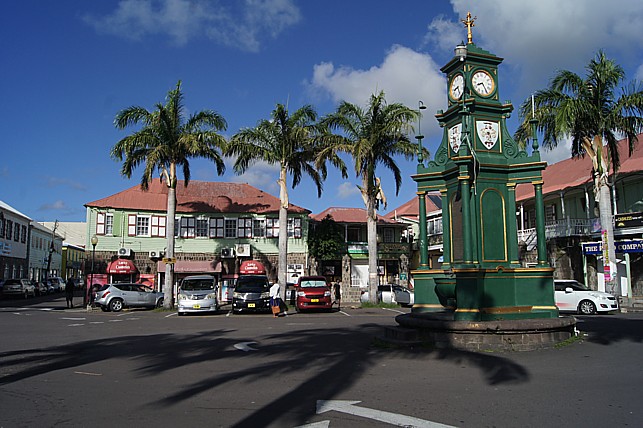
The starting point for any tour of Basseterre is logically Basseterre
Circus which is considered by many to be the hub of the town, as several
streets meet at this point. The Basseterre Circus came to be because of a
fire that occurred in 1867 and destroyed most of the town. In an effort to
prevent future destruction of the town it was decided to make the streets
wider so that the fire truck could more easily get around and to create the
Circus. At the center of the Circus is the Berkeley Memorial which was
erected in 1883. The memorial is in memory of Thomas Berkeley who owned
several estates on the island and served as a legislator. Designed and
produced by George Smith and Company of Glasgow, Scotland it is the only one
of this design that has survived. As part of the memorial there is a clock
and a drinking fountain and it is a popular meeting place for locals.
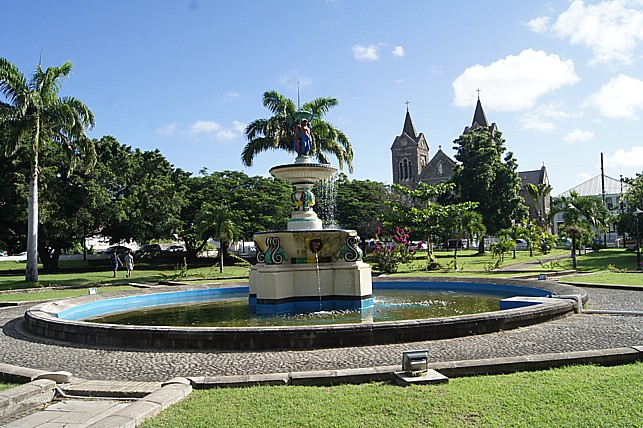
A short walk from the Circus is Independence Square. Formerly called Pall
Mall Square the name was changed on 19th September 1983 to commemorate the
independence of St Kitts and Nevis. The land for the Square was acquired in
1758 and was acquired for the use of the public. In 1855 to improve the
sanitation in the town it was decided that pipe borne water was needed. When
the water project was completed a stone fountain was built in the center of
the square to commemorate this significant development. At the summit of the
fountain there are three Grecian styled ladies and a small child.
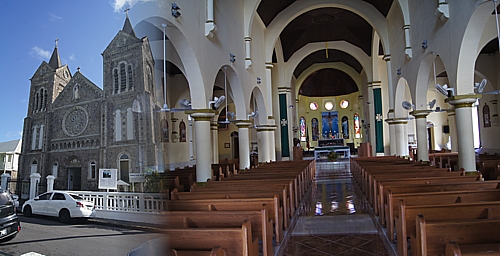
On the eastern side of Independence Square is the Co-Cathedral of the
Immaculate Conception. The early French settlers of St Kitts built a
Catholic Church and dedicated it to Our Lady of Notre Dame, however this
church was burned in 1706 during the Anglo-French war and rebuilt later as
St. Georges Anglican Church. Eventually a new Catholic Church was built but
in 1852 it had to be replaced and then by the 1920's that church had to be
replaced. Construction of the present church started in March 1927 and by
December 1928 it had been completed. Many of the items in this grey stone
church are items from the earlier churches; even the pavement tiles were
removed in 1927 and then reused when the new church was being constructed.
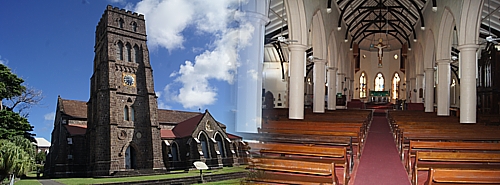
A short walk from the Cathedral of the Immaculate Conception at the head
of Church Street is St George's Anglican Church which is the largest church
on the island. The outer walls of the church are of heavy andesite rock and
the roof is covered in slate. Over the years this church has been destroyed
by either fire or hurricane on several occasions and rebuilt each time.
Construction of the present church started in 1867.
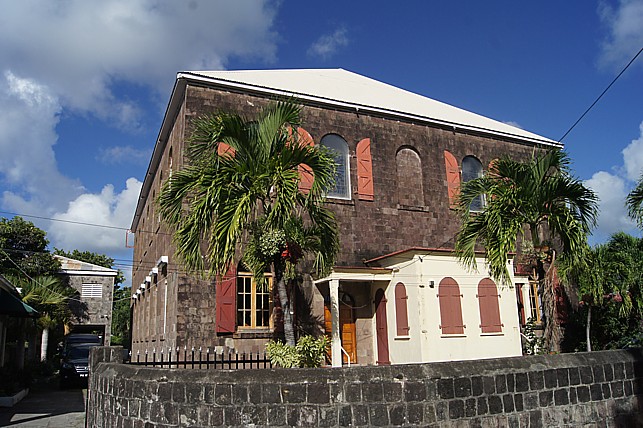
If one slips through the churchyard of St Georges you come upon a solid
square brick building. It is only upon reading the sign to the front of the
building that you realize this is the Wesley Chapel, also referred to as the
Methodist Church. In 1787 William Hammet, a Methodist missionary, purchased
the land for the church and in 1788 a wooden church was built and then
enlarged in 1803. In 1822, a building of dark stone measuring 75 feet by 55
feet that could seat a congregation of 1500 replaced the wooden structure.
The Chapel survived the numerous disasters that caused so much damage in
Basseterre over the years that followed its construction and is now the
oldest public building in the town.
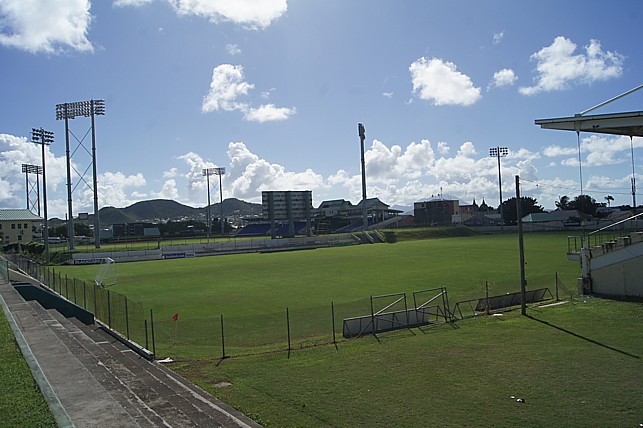
Almost across from the Methodist Church is Warner Park. In 1926 the
Legislature bought the property with the express purpose of creating a park.
Over the years this has become the main sporting venue in St Kitts. St.
Kitts hosted CARIFESTA in 2000 and the Park was the scene of both the
opening and closing events. In 2004 Warner Park was chosen as one of the
venues to host games of Cricket World Cup in 2007. This led to a complete
renovation and in 2006 the Park hosted its first international cricket match
between the West Indies and India. In 2007 Australia, the Netherlands,
Scotland and South Africa played games here as part of the World Cup
tournament. Since then Warner Park has also become the venue of the St.
Kitts Music Festival.
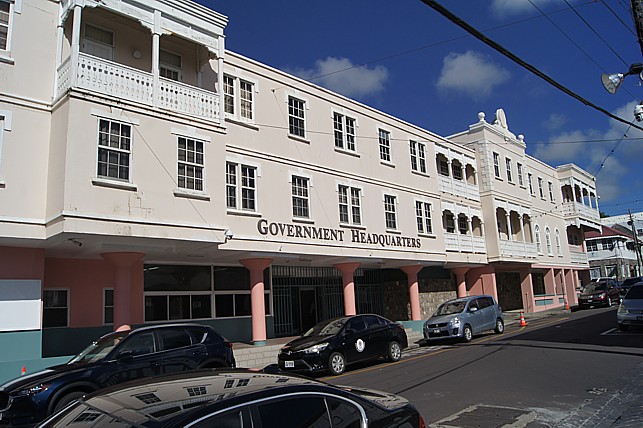
If we retrace our steps and head back on Church Street we will eventually
encounter the Government Headquarters. This building while not being a
colonial era building as it was constructed in 1994 seeks to incorporate
some of the features of that era.
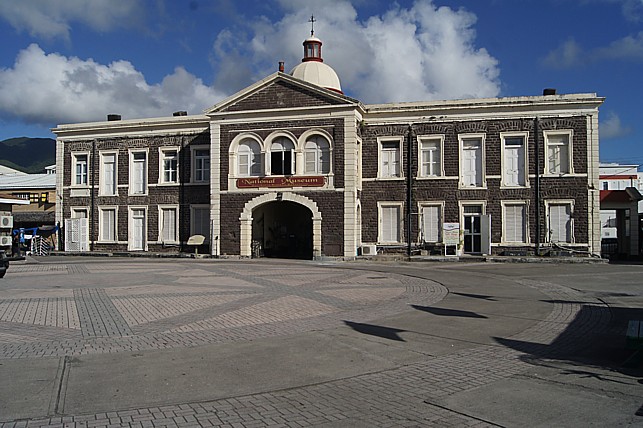
If we continue our walk through Basseterre we will eventually arrive back
at Basseterre Circus and facing the Circus is the St Kitts National Museum,
where you can explore the nation's history and learn about some of the most
significant historical figures. The National Museum is located in what used
to be the Treasury Building. It is also the home of the St. Christopher
National Trust. Once situated on the Basseterre Bay front, the building is
now at the meeting point of Basseterre and the reclaimed land of Port Zante,
which is the Cruise Ship Complex.
While some Caribbean islands are known for their raucous
atmosphere, St. Kitts and its residents are content being quiet, peaceful and devout.
Though the island certainly isn't without plenty of fun, the spiritual nature of St.
Kitts' residents seems to grant a calming influence to all who visit. Like many other
destinations known for being peaceful and contemplative, life for locals in St. Kitts
seems to revolve around the churches and their rich histories. As the population of St.
Kitts is small compared to other popular Caribbean islands, the island has only two main
churches. However, these churches - a Roman Catholic cathedral and an Anglican church -
are two of the most important buildings on the island and should be part of any
sightseeing tour in Basseterre.
One of the most impressive structures in St. Kitts is the Cathedral of the Immaculate
Conception, a Catholic church that dates to the 1920s. Though the cathedral is not yet 100
years old, a number of colonial churches have stood on the land since the early 18th
century. The original Catholic cathedral was built on this picturesque plot in 1706.
Initially known as the Cathedral of Notre Dame, the French-built structure was destroyed
only four years later by invading British troops. With St. Kitts under British control,
the church was rebuilt in 1710 as the island's primary Anglican church. For the next
century, Roman Catholics were persecuted by the British and forbidden from worshipping in
public. As a result, the Catholic population of St. Kitts was forced to practice their
religion in private, without a house of worship to call their own.
After a century of persecution, St. Kitts' Catholics were again allowed to practice
their faith in 1829. A few years later, a large group of Portuguese immigrants arrived on
the island, further increasing the island's diversity and St. Kitts' Catholic population.
With the support of these devoutly religious immigrants, St. Kitts' Catholic population
erected a new church in 1856. Now known as the Church of the Immaculate Conception, the
building served the island's Catholic community until 1927 when today's larger, more
ornate structure was erected. Today, visitors can tour the cathedral amongst the beautiful
surroundings of Independence Square, St. Kitts' historic park that is bordered by
well-preserved colonial buildings.
After St. Kitts' Catholic population reclaimed the site of their church in the mid-19th
century, the Anglican congregation built a new house of worship just east of the
cathedral. Like the original incarnation of the Catholic cathedral, St. George's Anglican
Church was built in the 1850s. However, unlike the Cathedral of the Immaculate Conception,
St. George's Anglican Church has remained intact for 150 years. Though St. George's has
been renovated several times following fires and storms, the remarkable colonial structure
is still in service today. Despite lacking the grandeur of the Cathedral of the Immaculate
Conception, St. George's Anglican Church is an important site in Basseterre and shouldn't
be missed when touring the city.
To the west of both primary churches, visitors will find the Springfield Chapel and
Cemetery. Also constructed in the mid-19th century, the Springfield Chapel and Cemetery is
an important religious and historical site for locals. In 1858, the government responded
to a cholera epidemic that had affected the island for four years by requiring all future
burials to take place at Springfield Cemetery. In 1862, the government of St. Kitts added
the non-denominational chapel to be used for all burial services. Today, the Springfield
Chapel and Cemetery serve as constant reminders of the island's unwavering faith and
unique colonial history. Just as many locals celebrate this site amongst the most
spiritual and uplifting in St. Kitts, many visitors have made the journey to the west side
of Basseterre to experience the rustic chapel and historic graveyard.
If you want to tap into the peaceful spirit of St. Kitts, these sites should be at the
top of your sightseeing list. While the churches in St. Kitts might seem modest at first
glance, these incredible buildings have incredible stories to tell to all who visit.
Justin Burch writes articles about travel in St. Kitts for the Marriott
Resorts.
Early in the 20th Century, a 30-mile railway was
constructed on St. Kitts to aid transportation of sugarcane crops to the island's colonial
capital, Basseterre. Today, this unique narrow-gauge railway has found a new life. As part
of St. Kitts' expanding tourism industry, the St. Kitts Sugarcane Railroad now serves as
one of the best ways to see this gorgeous island in its entirety. In addition to being the
most enchanting rail tour in the Caribbean, this railway provides one of the most scenic
train rides in the world.
Traversing a major stretch of the island, the railway will take you past many of the
old sugarcane fields. Though the crop is rarely harvested anymore, these plantations offer
a unique glimpse into the Caribbean's colonial past. Today, the countryside is dotted with
numerous active farms full of livestock and fruit crops, yet abandoned windmills and
smokestacks still populate the landscape. The small towns supporting these farms also
feature charming houses and other unique historic structures. Many travelers have also
noticed that children often come out of the rural schoolhouses to watch the train roll by
twice a day - an activity that offers students and teachers a regular break from studies.
After leaving the station, the train will head north along the St. Kitts' beautiful
coastline. Some of the first things you might notice are the numerous sidings - loading
points for harvested sugarcane - next to the tracks. As the train hugs the coastline in
the early going, you will probably also notice the rainforest-covered mountains of St.
Kitts rising above the aforementioned farms and villages. At the heart of the mountain
range, you will certainly notice Mt. Liamuiga - the volcanic peak visible throughout the
island. Stretching from the island's central mountain range are many deep canyons, some of
which extend all the way to the coastline's majestic cliffs. Spanning these canyons are 24
steel bridges - all of which are attractions in themselves.
Many of St. Kitts' most popular attractions are visible from the train, as well. As the
train circles the island, the conductor will announce such sites as Brimstone Hill
Fortress - the "Gibraltar of the Caribbean." While viewing such historic
structures and natural beauty, you will also be treated to a narrative history of the
island. To educate yourself even further, stop by the Basseterre Public Library after your
tour to view a permanent exhibit of photographs dating to the construction of the railway.
Unlike many other historic railways, the passenger cars of the St. Kitts Sugarcane
Railroad are as luxurious as the scenery. For the sake of the tours, the island
commissioned the construction of distinctive double-deck railcars. On the upper deck, you
will find a beautiful open-air observation deck. Down below, the air conditioned cars are
outfitted with comfortable furniture, full-service bars and even live entertainment - all
with a Caribbean flourish. As you don't want to miss anything outside, the oversized
windows will allow you to enjoy all the sites.
Utilizing 18 miles of the original railway, this two hour tour is the best way to see
the entire country in a short time. As only 420 seats are available each day, it is
recommended to buy tickets as early as possible through your resort or travel provider. As
travelers are promised captivating views of the Caribbean Sea, surrounding islands,
rainforest-coated mountains, magnificent cliffs and pristine wildlife - the St. Kitts
Sugarcane Railroad is the hottest ticket on the island.
It is even possible to take a ride on the railway during a shore excursion from one of
the many cruise ships that visit the island. Shuttles take passengers from the pier
directly to Needsmust Station. At the end of the tour, shuttles will available for travel
back to the pier or any of the island's resorts.
If you are looking for the best way to see St. Kitts - or maybe just a ride you will
never forget - climb aboard the St. Kitts Sugarcane Railroad.
Though the
historic and scenic capital of Basseterre certainly deserves to be the
most-visited community in St. Kitts, there are several towns across the
island that offer unique tourism opportunities. One such destination is the
peaceful town of Cayon, a coastal village resting in a verdant seaside
valley just a few miles from Basseterre. Though the scenery and friendly
spirit of Cayon can be appreciated throughout the year, the town is an
especially exciting destination during the annual late spring celebration
known as the Green Valley Festival. Despite being little-known outside of
St. Kitts, the Green Valley Festival is actually the island's second-largest
event behind the immensely popular national Carnival celebration. Those
visiting Cayon can also explore Spooner's Ginnery, one of the most
interesting historic industrial sites in the Caribbean.
Though the town
of Cayon receives far fewer visitors than the capital city of Basseterre,
this austere community is said to be one of the friendliest in St. Kitts.
Much of the town's welcoming nature seems to stem from the locals'
spirituality - the small community is home to nine distinct churches - and
simple, relaxing way of life. Cayon is also home to some of the St. Kitts'
most unique scenery, as the town rests in a mountain valley near the
Caribbean shoreline that is surrounded by verdant pastures and sugar cane
fields.
While the scenery
of Cayon is certainly a worthwhile attraction, the town has far more to
offer during the month of May. Each year since 1997, the Green Valley
Festival has helped St. Kitts welcome the summer season with live music,
unique Caribbean cuisine and other special events. Since its inception, the
Green Valley Festival has represented a true community effort, as citizens
of Cayon organize and operate the event with the assistance of a select
group of local sponsors. Having expanded each year, the Green Valley
Festival now features a expansive lineup of local and regional musicians -
performing everything from reggae, calypso and other Caribbean genres to
soul, gospel and rock - numerous food vendors offering island-inspired
cuisine and artists selling their hand-crafted creations. Much of the action
at the Green Valley Festival revolves around centrally located Maynard's
Park, site of the primary music and event stage.
One of the most
popular events at the Green Valley Festival is the elegant and uniquely
Caribbean Queen Pageant. Each year, several local women don their most
ornate, island-inspired dresses and compete on stage for a chance to
represent the close-knit community and a seat of honor in the festival's
closing parade. During the parade, the Green Valley Festival Queen rides
amongst local marching bands, dance troupes and other costumed performers
that demonstrate some of the region's lesser-known art forms. As the closing
parade traverses nearly all of Cayon, excellent vantage points can be found
on several of the town's narrow streets.
One of St. Kitts'
most interesting colonial sites rests along the northeastern shore, just a
few miles from Cayon. Spooner's Ginnery - also known as Spooner's Estate -
is home to the last remaining cotton ginnery on St. Kitts, one of the most
significant relics from the island's transition from colonial rule to a
modern economy. From the mid-18th century until the turn of the 20th
century, Spooner's Estate served as one of the island's most productive
sugar mills. After the property changed hands, the new owners converted the
steam-powered sugar mill to a mechanical gin and began growing cotton in the
rolling fields. Spooner's Ginnery remained in operation until the 1970s when
the local government purchased the property and began treating the site as
an unofficial historic destination. Today, visitors to Spooner's Ginnery can
explore ruins that span three centuries of St. Kitts' unique industrial and
cultural history. The site of the ginnery also offers excellent views of one
of the most peaceful, rural landscapes on the island.
When visiting St. Kitts, tourists that want
to experience the quiet charm of local life are encouraged to visit the town
of Cayon. Though the month of May stands as the most exciting time to visit
this area, tourists visiting any time of the year can still revel in Cayon's
scenic seaside location and friendly atmosphere.
Plenty of travelers are aware of the African influence on Caribbean
tradition, but very few seek out the most unique elements of this incredible
culture. In St. Kitts, traces of African culture can be found throughout the
island in everything from artwork to cuisine. Yet, the island's traditional
performers offer one of the best ways for tourists to enjoy the diverse
culture of St. Kitts. The most well-known of these performers are the moko
jumbies, the famous stilt dancers recognized throughout the world. If you
want to witness a truly remarkable performance while in St. Kitts, seek out
the Caribbean spectacle provided by the moko jumbies.
The
tradition of the moko jumbies has its origins in West Africa. It is believed
that the term "moko" references an African god or spirit, while "jumbie" is
most likely derived from a West Indian term for "ghost" (therefore, "moko"
can be treated as the African figure, while "moko jumbie" represents the
Caribbean derivative). In African custom, the moko would be responsible for
watching over his village. Using his incredible height, the moko would be
able to predict all types of danger and protect his people from evil. This
important member of the tribe was rendered in artwork and performance as man
on giant stilts capable of unexplainable feats.
The
moko jumbies entered Caribbean tradition during the colonial period via the
performances of West African slaves. After the African custom arrived in the
region, the story of the moko and the dance of the moko jumbie were adapted
to incorporate the new scenery. The new story claimed that the moko walked
across the ocean to the islands and, despite the hardships of slavery,
retained his pride and ability to protect his people. While those of African
descent were resigned to celebrate this story amongst themselves for
centuries, the moko eventually found his place in the Carnival celebrations
of the Caribbean. By the early 20th century, the dancers - now known as moko
jumbies - had become one of the most popular cultural attractions in the
Caribbean.
While the popularity of moko jumbies waned during the second half of the
20th century, the tradition has experienced an incredible resurgence in the
last 15-20 years. Like those traveling during the high period of the moko
jumbies popularity in the early 1900s, tourists visiting the Caribbean today
will be able to experience the joy of this unique performance throughout the
region. In fact, the moko jumbies have become such a popular attraction that
performances are held regularly throughout the year in St. Kitts and the
dance is incorporated into many other cultural events.
The
moko jumbies are certainly hard to miss in St. Kitts. The performers
typically wear long gowns and spiked headdresses that resemble a macaw plant
in bloom (some theories hold that the term "moko" may also be derived from
the name of this tropical plant). In most cases, the moko jumbies dance atop
six to eight foot stilts, allowing them to look down upon the crowds and
interact with captivated visitors in balconies and second-story windows.
Viewers often note the great suspense in watching the moko jumbies dance, as
the performers can seem on the verge of falling over at any time. Of course,
the moko jumbies are skilled dancers and only feign collapse to garner
applause from their audience.
Though the moko jumbies perform throughout the year in St. Kitts, the best
times to view all the diverse elements of the island's unique culture are
during the New Year's and Carnival seasons. During these annual
celebrations, the moko jumbies will be joined by an incredible assortment of
performers. Much as the moko jumbie tradition has its roots in West Africa,
each group of performers in St. Kitts draws from a distinctive cultural
influence, mirroring the rich history and cultural diversity of the island.
If
you want to experience the vibrant culture of the Caribbean, you won't find
a better island than St. Kitts. As the fascinating tradition of the moko
jumbies represents just the tip of the iceberg, a vacation spent in St.
Kitts can offer a wealth of wonderful sights and unique experiences.
Justin Burch writes articles about travel in St. Kitts for the Marriott
Resorts.
Resting only a few miles apart in calm Caribbean waters, St. Kitts and Nevis
have always shared an intimate relationship. Today, that relationship finds
St. Kitts as one of the Caribbean's premier travel destinations, while the
smaller island of Nevis offers plenty of great activities for day tripping
tourists. Though St. Kitts remains a superior resort destination with more
tourist opportunities, the islands have much in common. For starters, both
islands feature dormant volcanoes at their center, each surrounded by lush
rainforests with miles of hiking trails. Furthermore, as St. Kitts and Nevis
represent former colonial outposts with economies once dominated by
successful sugar plantations, both islands possess an incredible array of
historic architecture. Lastly, as most visitors to the Caribbean take great
interest in the beaches and the recreation opportunities provided by the
Caribbean Sea, tourists will find plenty of warm, clear water and powdery
sand wherever they travel.
Rising over 3,200 feet above the Caribbean Sea, Nevis Peak dominates the
landscape of St. Kitts' sister island. Similar to Mt. Liamuiga at the center
of St. Kitts, Nevis Peak is surrounded by lush trail-filled rainforests and
diverse plant and animal life. As a result, hiking and biking in the shadow
of Nevis' dormant volcano are two of the most popular activities for
day-tripping tourists. With tours available for every age and skill level,
visitors can spend a few hours experiencing the unspoiled beauty of Nevis
and learning about her vibrant Caribbean ecosystem.
Scuba divers and snorkelers will also want to spend an afternoon on Nevis,
enjoying pristine coral reefs and ship wrecks. As only 2 miles of Caribbean
waters separate St. Kitts and Nevis, many of the best diving tours visit the
most popular sites surrounding both islands. Many of the other water sports
popular on St. Kitts can also be found on Nevis. A number of tour operators
cater to deep sea fishermen and wind surfing enthusiasts, with many offering
lessons for those new to the adventurous pursuits. After spending some time
in the water, many day-trippers spend their afternoons relaxing on Pinneys
Beach - one of the Caribbean's most beloved stretches of sand.
If you would rather spend your day on land experiencing Caribbean history,
there are plenty of sites worth visiting on Nevis. Much like the historic
city of Basseterre on St. Kitts, much of the activity on Nevis revolves
around the island's colonial capital - Charlestown. Walking the streets of
this quiet city, you will see charming remnants of the island's history
around every corner - from Anglican churches and the Caribbean's first hotel
to elegant plantation homes and the childhood residence of an American
founding father, Alexander Hamilton. Elsewhere on the island, you can spot
the remains of the once-bustling sugar industry in the form of 18th century
plantations, windmills and mansions.
As St. Kitts sister island is close enough to be visible from the beach, a
short ferry ride is all that is required to access the small island of
Nevis. For many visitors, the 45-minute ferry ride itself is a memorable
activity, as the trip provides exceptional views of both islands and the
crystal-clear waters of the Caribbean Sea. Furthermore, as the ferries
operate daily from the early morning until the evening hours, it is easy to
spend the afternoon on Nevis and return to St. Kitts for the superior dining
and nightlife.
Additionally, many tour companies operate on both islands, making it
possible to find activities on Nevis through your resort on St. Kitts.
When in St. Kitts, try to make the short voyage across the Caribbean to
Nevis. Though St. Kitts may feature superior resorts and recreation
opportunities, it is hard to deny the charm of St. Kitts' little sister.
Justin Burch writes articles about
travel in St Kitts for the
Marriott Resorts.
Less than 20 years ago, the picturesque
southeastern peninsula of St. Kitts was accessible only by boat. Though the
island is small, no passable roads existed for locals and tourists to visit
the undeveloped beaches of the Atlantic coast. In 1989, however, its
completed work on a remarkable roadway that would connect the corners of the
island and offer visitors a scenic route to tour the Caribbean landscape.
Known officially as the Dr. Kennedy Simmonds Highway - named for the
island's first prime minister - this road remains one of the most important
developments in the island's history and great way to see everything St.
Kitts has to offer.
If you are like most of the Caribbean's
visitors, you will probably want to spend a good part of your vacation on
the beach, admiring the weather and the scenery. On St. Kitts, some of the
best beaches are located along the narrow southeastern peninsula accessible
by the Simmonds Highway. While the beaches in this area are typically not as
wide as those near the island's capital city, Basseterre, most are known for
their powdery sand and excellent views. One of the most popular beaches on
the island's southern shore is Friar's Bay, site of some exciting new
developments. Locals and knowledgeable tourists will also recommend the
beaches at Sand Bank Bay, Cockleshell Bay and Banana Bay.
After the Simmonds Highway began providing
access to the southernmost part of the islands for locals and tourists
alike, several developments started taking shape. One of the most ambitious
projects is the sprawling Whitegate Development Project. While parts of the
complex are still in the planning stage, the Whitegate Development Project
will include the Beaumont Park Racetrack and the luxury area known as
Kittian Heights. Located at Dieppe Bay, this project will incorporate
several new restaurants, shops and tourist opportunities in the coming
years. The most exciting project for families will be the four-acre theme
park known as Marine World. Situated on the shore at South Friar's Bay,
Marine World will allow families to view local marine life in
state-of-the-art aquariums and participate in dolphin encounters.
Though most of the activity along the
Simmonds Highway takes place on the beaches, there is plenty to see before
the end of the road. The road begins at Frigate Bay on the western half of
the island and winds its way through many of St. Kitts' best sightseeing
spots. Much of this scenery at the island's interior was generated by
volcanic activity. Along the Simmonds Highway, you will pass one of the most
picturesque volcanic sites on the island - the Great Salt Pond. Known for
its sparkling pink color, this water-filled volcanic crater is one of the
most photographed sites along the highway.
As you progress down the 6 ¼ mile highway,
you will probably notice the coastal terrain becoming rockier. Exposed to
the winds and waves of the Atlantic Ocean, the southeastern portion of the
island will greet all visitors with an incredible scenic contrast to the
calm beaches just a few miles to the northwest. After passing through the
grassy, rolling hills near the beginning of the highway, rocky cliffs and
lagoons will come into view. Amongst the windswept coves you can find one of
the locals' favorite hangouts - Turtle Beach. As grazing cattle and goats
find their way to the tiny beach, locals enjoy fresh seafood at the one of
the most charming restaurants on the island. Of course, visitors are always
welcome to join in on the food and fun.
Though taxis and some tour buses cruise along
the Simmonds Highway, the best way to see the sites is renting a car. At
your hotel or resort, you will be able to find information on daily car
rentals and your concierge may be able to reserve a vehicle for you. As
there is plenty to see in just over six miles, you may also want to ask your
concierge for tips on the best way to see the southeastern peninsula.
If you want to see all the natural diversity
that St. Kitts has to offer, take a ride down the Simmonds Highway. With
white sand beaches, rolling hills and windswept cliffs in just over six
miles, you might not find a more scenic road anywhere in the Caribbean.