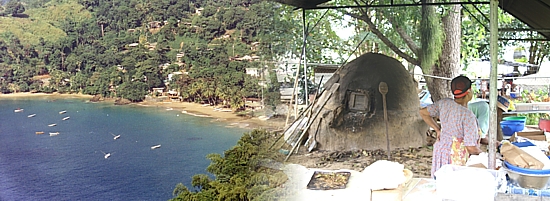
What is so special about baking in Castara to warrant an article encouraging people to
visit? The answer is an aroma and taste that can only be obtained by truly old style
baking methods.
Castara is on Tobago’s Leeward coast shortly before Englishman’s Bay. There
are different routes to Castara depending upon where you are staying in Tobago. If in the
Charlotteville area you simply take the North Coast Road, going through Parlatuvier and
continuing on to Castara. Visitors in Roxborough can use the Roxborough Parlatuvier Road
and turn south at Parlatuvier. Those who are holidaying along Tobago’s south west
coast can drive using the Grafton Road to get to Plymouth and then using the Arnos Vale
Road to go to Moriah and on to Castara. Vacationers in Scarborough have a variety of
routes to get to Moriah and then proceed to Castara. Whichever route you use to get to
Castara it is a scenic drive along hillsides with sometimes distant views of a blue sea
and other times beaches close by that make you want to stop and immerse yourself in the
water. Along the way you pass through villages where houses seem to cling to hillsides and
little children play in the streets.
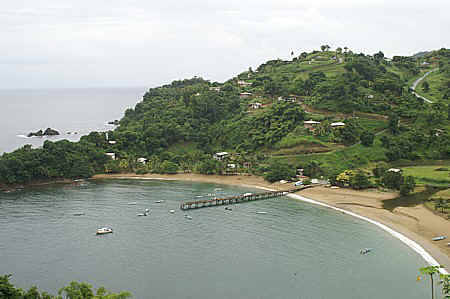
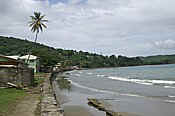
Castara is a small village clustered around a picturesque bay of blue green water
gently lapping onto a beach of golden sand. The small houses in the village climb the
hillside and interspersed among them are rustic guesthouses and local restaurants. Each
day the fishermen land their catch on the beach and if you are lucky you can see them
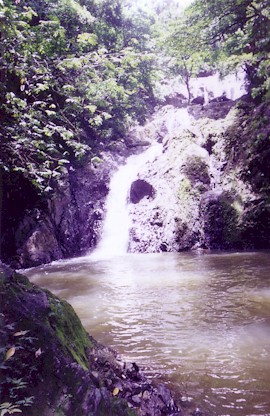
roast a few on galvanise sheets over a wood fire. A short walk away from the village is a
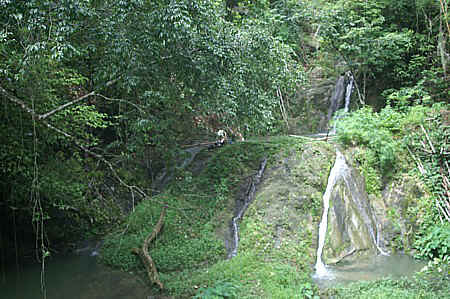
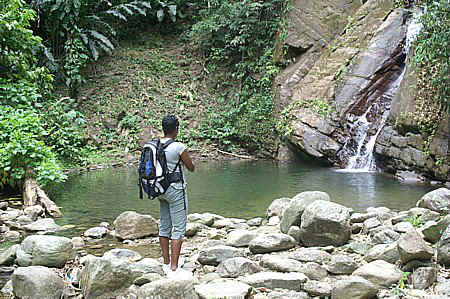
small waterfall and pool where refreshingly cool water invites you to soak your cares
away.
No visit to Castara however would be complete without viewing and tasting the products
baked there. In this village you can get locally baked breads (including a delicious
pumpkin bread), cakes, sweetbread, and coconut drops (these are so soft and moist that
they break apart just using your fingertips and fill your mouth with flavour).
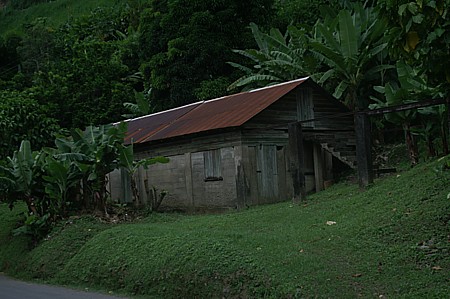
What is the secret – an old time dirt oven that uses a wood fire, dough wrapped in
wet banana leaves and preparation methods developed over years. These delicious products
are baked by a group of senior citizens who have been baking with this method for decades.
The oven is located just off the main road across a small stream and directly in front of
the beach. You can witness the entire process from the firing of the oven to the placement
of the dough to the removal of the finished product that fills the air with a wondrous
aroma. Locals and visitors alike come to Castara from surrounding areas to purchase and
observe a baking method that is now rarely seen.
Spend the day watching the baking process, bathe in the sea, refresh yourself in the
waterfall, have lunch at one of the local restaurants. Be forewarned however, if you want
to purchase some to the baked products, come early to place your order because all are so
delicious they are sold almost the moment they come out of the oven and the baking is only
done on Thursdays and Saturdays.
The video below shows the entire baking process from preparing the banana
leaves, lighting the fire, preparing the dough through to removing the
breads and cakes from the dirt oven.
Fort King George is
a commanding presence overlooking Scarborough, Tobago and definitely one of the places of
interest on this Caribbean island. This historical attraction is one of the places that
every visitor to Tobago should visit as it is the island's best preserved historical
monument.
Although Scarborough is the capital of Tobago, Fort King George was not always the main
defensive point for the town. Up to 1771, the British troops in Tobago were quartered at
Fort Granby in Barbados Bay, however given the distance from Scarborough (approx 6 1/2
miles) and the poor land communications at the time, a decision was taken to construct
barracks at Scarborough Hill. By May 1781, some barracks had been constructed. In June
1781, the French attacked and captured Tobago from the British. The French added to the
buildings on Scarborough Hill and named the fortification Fort Castries but their main
fortification was on Morne Cotton to the northeast of the town at a height of 800 feet.
Today Morne Cotton is known as French Hill or French Fort and houses several
telecommunication towers. On 14th April 1793, the British landed at Great Courland Bay and
recaptured Tobago from the French. From 1793, the main British Troops were stationed
on Scarborough Hill and the fortifications came to be called Fort King George, while Fort
Granby fell into disuse. From 1797 to 1854 structures were added to the fort largely
because of a fear of French attack. In January 1854, British troops were removed from
Tobago.
Today Fort King George sits at a height of 450 feet above sea level welcoming all to visit
and remember the past while admiring the panoramic view of Scarborough, southern Tobago,
the east coast and the central hills.
Access to the fort is very easy, you simply follow Main Street into Fort Street
and proceed up the hill going past the hospital grounds to emerge in the
midst of the fort. Here you will find well manicured grounds with solid stone walls and
darkly gleaming cannons poking through the parapets, still guarding the approaches to
Tobago. Around the grounds you can see the former prisoner cells, bell tanks, officer's
mess, military cemetery and powder magazine. Across from the powder magazine is a
beautiful spot where you can sit in the shade of a large tree and soak in the visual
beauty of Scarborough's harbour. There is a functional lighthouse that was built in
1958.
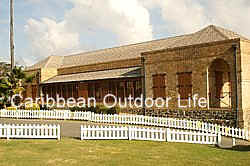
The focal point of the fort however is the refurbished barrack guardhouse which now
houses the Tobago Museum. One of the aspects of Tobago’s past that is not often
recognised is that Tobago had a significant Amerindian culture. Part of the reason the
Amerindian influence is not as strong in Tobago is that in 1606 the Spanish settlers in
Trinidad were uncomfortable with having a powerful Amerindian people so close and they
attacked Tobago with the intention of wiping out the Amerindians who lived there and
taking the women and children to be slaves in Trinidad. In the museum there are numerous
Amerindian artifacts (tools, weapons, artefacts) that have been found across Tobago with
some dating back to 2500 B.C. The Tobago Museum also displays many military artifacts
reflecting the military history of Tobago, which changed hands 30 times as the European
powers fought over the island. The museum which is open from 9am to 4.30pm Monday to
Friday also has a good collection of African art, reflecting the slave history of Tobago's
population.
Scarborough the capital of Tobago is an old town having become the capital
of Tobago in 1769 when the legislature was moved from Georgetown which is
now known as Studley Park. As an old town, Scarborough has several historic
buildings and most of these are within walking distance of each other,
perfect for an early morning stroll.
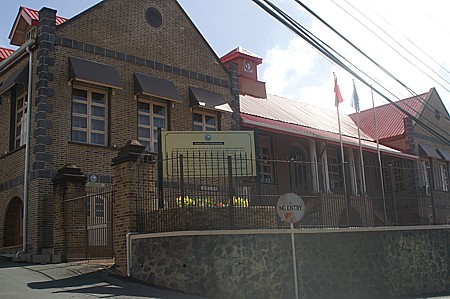
At the corner of Piggot and Burnett Streets is a brown brick building which
is the seat of the Tobago House of Assembly. The history of this building
goes back to to 1781 when the building was a courthouse in the period when
the French ruled Tobago. In 1821, under English rule the House of Assembly
was formed and a new building was erected on the site. In addition to
functioning as the seat of the Assembly the building also functioned as a
church holding service for the Catholic and Protestant churches. More
information on this building can be found in the section titled
Scarborough Courthouse.
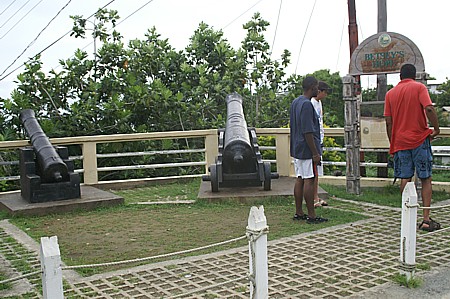
Just up the street from the Scarborough Courthouse along Bacolet Street is
Gun Bridge where the barrels of 19th century Brown Bess muskets are embedded
into the sides of the bridge as a memorial to the numerous wars that were
fought over Tobago. Just after the bridge heading west is the Anglican
Church which was opened in 1819 and previously church services were held in
the courthouse. The original church was destroyed by Hurricane Flora in 1963
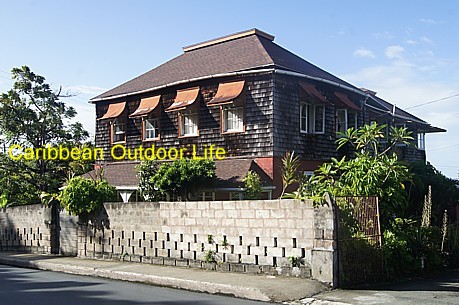
and rebuilt in 1964. Adjacent to the church is the home of the Anglican
priest which is a lovely example of a clapboard building atop a brick lower
floor.
Literally across from the clapboard house is the St Joseph's Catholic Church
which was established in 1892. Almost at the side of the Catholic Church is
the former Scots Kirk. In 1807 a request was made by a plantation owner to
the Church of Scotland for persons to be sent to Tobago to minister to the
slaves. In 1813 the London Missionary Society built a church (known as a
kirk) in Scarborough. Unfortunately by 1841 the number of persons who were
members of the church was too small to continue the church and it was
decided to dissolve the congregation and lease the building to the Anglican
Church who converted the Scots Kirk building into a girl's school.
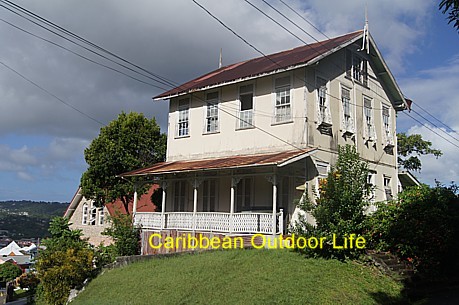
Another historic building in Scarborough is the Methodist Church on Fort
Street. The Wesleyan Methodists originally has a small chapel on Market
Square in 1817 but in 1823 they began efforts to construct a new church and
in 1824 the foundation stone for the church on Fort Street was laid with the
building being completed in 1826. This building was built using the bricks
that had served as ballast on ships coming to Tobago to collect sugar. Just
above the church along the street is the original home of the Methodist
minister for the church.
Further up Fort Street is Tobago is Tobago's most historic structure, Fort
King George, which was started by the British in 1781. When the French
captured Tobago they added to the fortifications and when the British
recaptured Tobago in 1793 they further added to the Fort. More information
on Fort King George can be found earlier on this page.
Directly opposite A.P.T. James Square (formerly Market
Square) in Scarborough Tobago is a brown brick building behind an iron
railing. The square in front the building which is now called A.P.T. James
Square after a Tobago politician, was previously called Market Square and
until 1807 was the site of the market for African Slaves. The brown brick
building is the seat of the Tobago House of Assembly but its history goes
back beyond the formation of the House of Assembly. In 1781, Tobago was
captured by the French and during this period there was a court house at
this site, however during a rebellion of the soldiers stationed at the fort,
the building was destroyed by fire. In 1814, Tobago was formally ceded to
Britain and a system for running the island known as the House of Assembly
was created. To provide a home for the government it was decided that a
building had to be erected and so on April 23rd 1821, the Governor General
Sir F.P. Robinson laid the foundation stone and the building was completed
in 1825. The completed building included a courtroom, chambers for the
Tobago House of Assembly and an office for the Governor.
The basement floor was constructed of Scottish firebrick, imported as
ballast in the holds of sugar ships, and contained a stable as well as a
small jail cell. The upper floor was of mortared and un-plastered limestone
quarried locally. An interesting example of harmony was that both Protestant
and Catholic services were conducted in the court room until houses of
worship were built for both denominations.
Jewish settlement is not often associated with Tobago.
While one can find
traces of the Jewish presence in Trinidad, thru street names, sections
of cemeteries, businesses, it is hard to find traces of Jews in Tobago. Yet
there was Jewish settlement in Tobago.
Jewish settlement in Tobago is tied to the effort of
the Dutch to settle what they called the Wild Coast of the Americas; the
region between the Caribbean and Brazil. Tobago was included in their plans
because they felt that their ships sailing to/from Brazil could stop in
Tobago without being seen by the Spanish. Plus they believed that Tobago
provided land for growing sugar and cocoa.
The Dutch allowed Jewish people to be among their
colonists and allowed them to exercise their religion. The Dutch allowed
Jews to settle in their lands because they had seen in Brazil how good the
Jews were in growing and refining sugar plus their expertise in shipping and
commerce. In 1659 120 Jews from Livorno came to Tobago and in 1660 a further
152 Jews came from Livorno. These Jews had been told that they were sailing
to Cayenne, in what is now French Guiana, but they were dropped off in
Tobago. The Dutch settlement was called Lampsinsstad, and built on the site
of the current capital, Scarborough.
In 1678 the Dutch settlement in Tobago was wiped out by
the French. Although the Dutch settlement was wiped out by the French there
was also a Latvian settlement at Courland Bay that survived on the island
until 1693 and the Latvians also allowed Jews to settle in their colony.
Eventually most of the Jews left Tobago going to either
Amsterdam, Martinique or Cayenne. It is believed that most left because they
did not know how to operate agriculture in these tropical lands and they
were not provided with adequate supplies to keep them functional until they
could become self-sufficient.
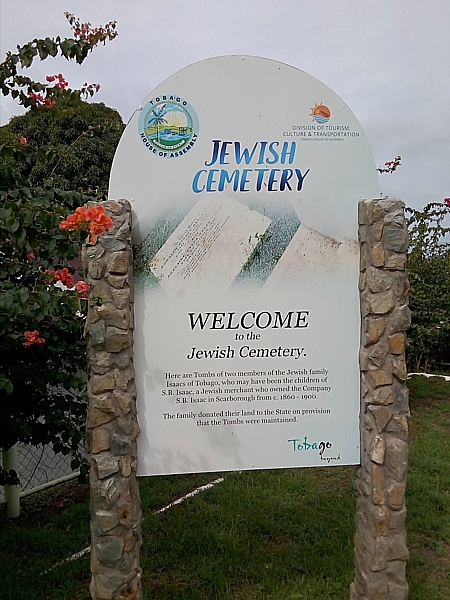
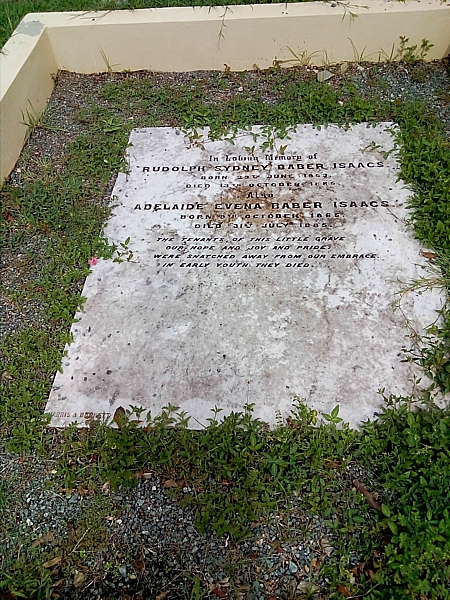
Today the only physical evidence in Tobago of the
presence of these Jewish colonists are two graves in, Upper Scarborough
(behind Fire station, Old Health Centre Compound, now Office of CMOH),
Tobago. The graves bear the names Rudolph Sydney Baber Isaacs born 1847 and
died 1885 and either his wife or sister Abigail Evena Baber Isaacs born 1865
and died 1885. Rudolph is believed to be the son of Solomon Baber Isaacs.
The land on which these graves lie was given to the Government by S.B.
Isaacs on the condition that the graves be maintained.
S.B. Isaacs and Company operated in Scarborough from
1860 to 1906, however there is evidence that S.B. Isaacs was a merchant in
Tobago for a much longer period. According to the Doctoral thesis of Susan
Elizabeth Craig-James - THE EVOLUTION OF SOCIETY IN TOBAGO: 1838 TO 1900,
the inter-colonial trade, particularly with Barbados, had been, from the
1830s, controlled by the smaller local merchants. Including S. B. Isaacs and
Company and they were one of the two of the firms owning the three sailing
vessels which plied between Tobago and Barbados. Also there is a record in a
History of Tobago by Henry Woodcock, that Providence & Dunvegan Estates were
owned by S.B. Isaacs in 1832.
We also see that in April 1884 Michael Baber Isaacs
instituted a liquidation of his assets in London England and that included
his share of the Tobago company, S.B. Isaacs and Company which was operated
in partnership with Solomon Baber Isaacs.
The botanic gardens in Scarborough is a quiet little oasis hidden in the
heart of the town. These Botanical Gardens cover 18 acres, are filled with a
variety of tropical plants but also have plenty of open spaces for quiet
relaxation. A visit to the Scarborough Botanic Gardens is one of the things
to do in Tobago. From the higher point of the botanical gardens near the
Bandstand you get a beautiful view of Tobago's ferry docks, boats and the
ocean.
There are two main access points to the Tobago Botanical Gardens. One is
just off the Claude Noel Highway and the other is on Gardenside Road in
Scarborough. The botanic gardens were once the Dal Fair and Rocky
plantations and were created in 1899 with seeds and plants native to West
Africa being brought to the Caribbean along with plants from Central
America. In the beginning the botanic gardens was the keeper of seeds such
as Rayme, cisal onions with Henry I Millen as the first curator.
Within the gardens are Royal Poinciana trees which is also called Flamboyant
or Flame of the forest, silk cotton, Samman, Almond, Mango and Pine trees
and there's an Avenue of Royal Palms. One shortcoming of these Botanic
Gardens is that there are no signs to indicate the names of the trees and
plants.
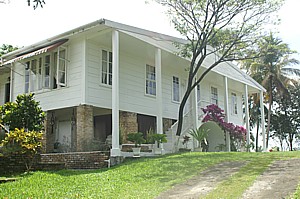
The Richmond Great
House is a restored estate house of the original Richmond Estate sugar
plantation and dates back from 1766. The original estate was devoted to
growing sugar cane however by 1886, the cultivation of sugar cane could no
longer support the estate. As a result in 1893 the estate was bought by a
retired English officer called Mayo Short who changed the estate to growing
cocoa and coconuts. Upon the death of Mayo Short the estate passed to is
son. Hurricane Flora in 1963 destroyed the crops of the estate and the
owners were not able to rejuvenate the estate. Eventually part of the estate
was sold in 1973 to Dr Hollis Lynch, a Tobago born Professor of African
History at Columbia University who bought the Great House and 4 acres of the
surrounding land.
The Richmond Great
House has a truly eclectic collection of pieces of art from around the world
collected by Dr Lynch, even the furniture is art. There are wooden and brass
African and Chinese furniture and a collection of African textiles and
carvings. In addition there are many original pieces of furniture and
cooking utensils from Tobago's early days. The Great House is built on a
hill top and the grounds around the house are filled with fruit trees. On
its grounds are two inscribed tombstones dated 1829 and 1840. The view from
the grounds is magnificent showing the hills of the Tobago Rain forest and
the Atlantic Ocean. There is a constant cooling breeze that flows over the
hilltop.
One can visit the
Great House on any day to tour the property. In addition parts of the house
have been converted into a guesthouse so that you can stay and sleep in the
rooms of the old sugar planters.
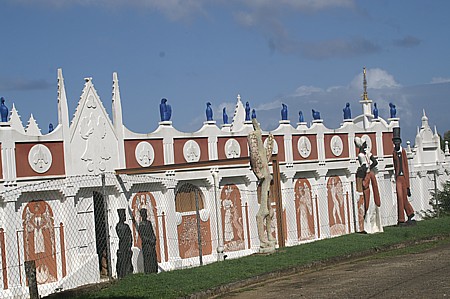
The Kimme Museum in Tobago is literally a must see. As
soon as you drive up to the building you realise why it is classified as a
must see and the exterior of the building is only the beginning of the "wow"
moments. Luise Kimme is a German sculptor who moved to Tobago in 1979 and
the museum is part of her home and workshop. The entire building is unique
and persons who live nearby call it the Castle, however with its commanding
view of the countryside and unique artistic and architectural finishes it is
probably like no other castle on earth.
Luise Kimme creates larger than life sculptures in wood and bronze, some as
much as 14 feet tall. The sculptures represent the life of Tobago as seen
through her eyes as well as reflecting her love of dance and nature. Words
often seem inadequate to truly describe these figures and they really
require being seen to grasp the magnificence of the work but once seen they
are never forgotten. The exterior of the building and the statues on the
outside gives a glimpse of what is in store for those who visit the museum
as there are approximately 100 sculptures housed inside.
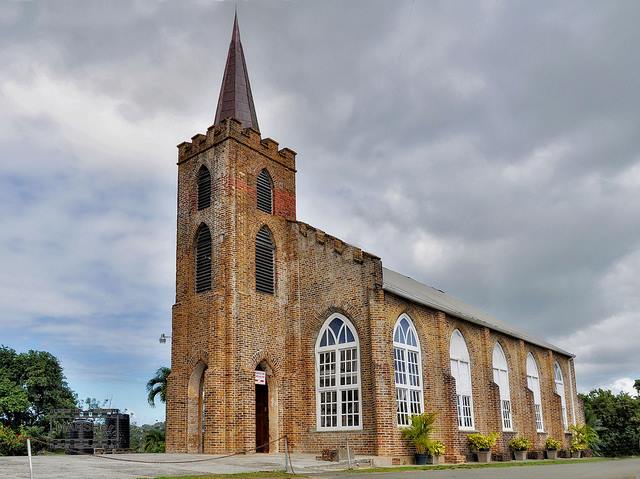
St Patrick's Anglican Church in Mount Pleasant Tobago is the oldest
surviving church on the island. While other churches were constructed before
St Patrick's, with St Andrews Anglican Church in Scarborough being built in
1819, all the other churches were destroyed by Hurricane Flora in 1963. Thus
St Patrick's is the oldest surviving church having been constructed during
1837 - 1843. This church sits atop a peninsula with a view of the sea on two
sides. Among the artifacts within the church are two Bibles that were used
when the church was commissioned in 1843. a bronze lectern bearing the date
1727 donated to the church by Sir Geoffrey Knox; an 18th century chalice of
copper plated silver; a baptismal shell of Mother of Pearl with a beautiful
carving of our Lord representing the Resurrection found by Cecil Anthony at
Buccoo believed to have been recovered from the wreckage of a French ship
that sunk more than 200 years ago; and pews that may have been installed
originally when the church was built. There are also relics of the horse and
buggy era at the front of the building.
One of the aspects of the construction of the church is that it is built of
fire bricks that were used as ballast on the ships coming from England &
Scotland during the slavery period. Very often these ships did not have
sufficient cargo to fill their holds during their voyage to the West Indies
to collect sugar and so used fire bricks as ballast in the ship hold. To
construct the church the slaves carried the bricks on their heads from the
bay at Mount Irvine to the site of the church on the hill in Mount Pleasant.
To the front of the church lies the grave of Jane Lovell, who was the last
surviving slave that carried bricks from the beach to the church and is
reputed to have lived for 100 years.
Every year is August, as part of the Tobago Heritage Festival the church
members conduct an Ancestral Walk from the Beach at Mount Irvine to the
church to commemorate the transportation on the heads of their ancestors of
the bricks used in the building of the church.
Tobago surprises you, as just around each corner is an interesting or
historical site.
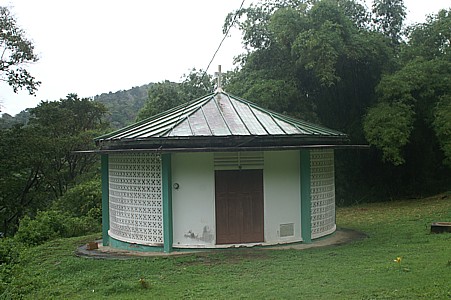
Just outside the village of Bloody Bay on the way to the Bloody Bay beach
facility is a Chapel at the side of the road. This chapel sits on the side
of the hillside and all around is clothed with the verdant Tobago Rain
Forest which is the oldest legally protected forest in the Western
Hemisphere having been designated as a protected Crown reserve on April 17,
1776. The grounds in the immediate vicinity of this circular chapel are
covered with low cut grass and low decorative shrubs. The interior of the
chapel has pews, an altar, a baptismal font and bronze artwork. This
chapel is available for use by any group that desires. So for those who come
by this area, the question that invariably arises is how did this chapel
come to be here?
On 7th March 1965, Dorothy Rood died in an accident near to the site of the
chapel and was buried at St Andrews churchyard in Scarborough. Dorothy had
loved Tobago and so her husband, John Rood, erected the chapel in memory of
her.
Located on Tobago's Northside Road between Moriah and Castara, this is a
tiny all in one rest stop with toilets, mini mart, tea shop and museum.
Called the Golden Heritage Museum it has a collection of historical
memorabilia.
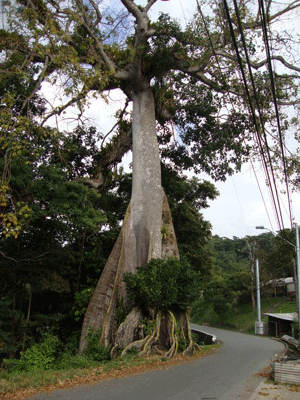
In Tobago there is a tree that is both revered and feared. Growing at the
side of the road with its roots edging against the asphalt, this tree has
been there for as long as anyone can remember. As it is so close to the road
some may ask why the tree has not been cut down. Well this is a Silk Cotton
Tree also called a Ceiba Tree or a Kapok Tree and there are many who fear to
cut it.
The Silk Cotton or Ceiba Tree is one of the largest growing trees in the
tropics. It can reach to heights of 80 feet and be as wide as 8 feet. Its
roots can be as tall as 10 feet and extend out from the trunk by as much as
10 feet. The fibers from the tree are used for insulation, padding in
sleeping bags and life preservers and for stuffing pillows.
The fear of the silk cotton tree is not restricted to Tobago but extends
throughout the Caribbean. In Guyana it is called the jumbie (evil spirit)
tree. Jamaicans believe that duppies (evil spirits) live in silk cotton
trees. In Trinidad there are some who believe that douens (children who died
without being christened) live among the roots of the silk cotton tree,
while others say that the devil or Bazil lives within the tree. It is
reported that in the 19th century people believed that silk cotton trees
could move of their own accord and would gather together in the night to
talk with each other. According to the historian Angelo Bissessarsingh this
fear of the silk cotton tree predates the colonization of Trinidad as the
original Amerindian inhabitants of Trinidad believed that spirits resided in
these trees.
This particular tree in Tobago has a legend that accompanies it. The legend
is that during slavery there was a woman called Gang-Gang Sarah who flew
from West Africa to Tobago to look after the spiritual needs of the slaves.
When Emancipation occurred and the slaves were freed, Gang-Gang Sarah
decided it was time for her to return to Africa. So she climbed to the top
of this tree and attempted to fly back but fell to her death. The legend
goes that she was unable to fly because while in Tobago she had eaten salt
and so had lost her power to fly.
Whether the legend is true or not, this tree survives to this day and there
are times when going past the tree you may see the remnants of red and blue
candles indicating that there are those who have come in the night to pray
to something at the foot of this tree.
Fresh or salt is a familiar cry uttered by Trinidad peanut vendors, however "fresh
or salt" takes on a different meaning in the island of Tobago. There is no denying
that beautiful beaches abound in Tobago with warm blue salt water gently lapping on the
shores. What is sometimes not recognized is that Tobago has many waterfalls with cool
clear fresh water falling into pools that invigorate both the body and the mind. So that
Fresh or Salt is a real choice in Tobago.
Many of Tobago’s waterfalls are close to the road so that it is a short hike to
visit them. One of the easiest waterfalls to view is the Craig Hall Waterfall. This
two-tiered waterfall is just off the road between Mason Hall and Mesopotamia and visible
from the road. The first tier falls into a large bathing pool that seems like a tub hewed
from the rock. The water then spills over the side of the pool and cascades down the solid
rock face into the river below. There is a concrete walkway leading to an area facing the
cascade, with benches, croton plants, bamboo and natural vegetation, which is perfect for
quiet contemplation.
Another waterfall that is easy to visit is the Castara waterfall on the southwestern
edge of Castara village. This idyllic little waterfall is easy to find, as you simply
enter River Road, go to the football field, walk across the field and the follow river
upstream. A clearly defined track runs along the edge of the river, at times crossing back
and forth across the river. As you walk along, clean water runs down and little fish
lazily swim in the pools. During the short ten-minute walk you cross through small
agricultural holdings with banana and cocoa. Along the way Jacamars regally stare from low
branches and Hermits dart across the stream visiting stands of heliconia on the hillsides
while other hummingbirds flit among the high branches of the immortelle trees.
If your Tobago journeys take you along the Windward Road on the Atlantic side of the
island, the Rainbow Waterfall is yet another of Tobago’s easily visited fresh water
delights. A turn off at Goldsborough Bay and then a 1.5 mile drive along a road that has
potholes but is navigable brings you to Rainbow Nature Resort. From there a short 20
minute walk through countryside that is beautified with ginger lilies, heliconias, and
majestic bamboo canopies, while butterflies, lizards and kingfishers keep your company,
brings you to Rainbow Waterfall. There you can revive your spirits at the sight of a
rainbow dancing in the water’s spray.
Another waterfall that can be easily visited from the Rainbow Nature Resort is the Twin_Rivers_Waterfall. This waterfall which is also known
as the Two Rivers Waterfall gets its name from the fact that at the base of the waterfall
two rivers join and continue down stream as the Goldsborough River. The Twin Rivers
waterfall is a tall waterfall that is broken into a series of small waterfalls and the
last fall is large dropping into a wide cool pool that is ideal for swimming. Experienced
hikers can climb to the top of the waterfall along a steep trail and at the top follow the
river to more pools and cascades. The trail to the Two Rivers waterfall is along the
Goldsborogh River, following the river upstream and walking mainly on gravel and small
rocks. Along the way there are some small rapids that are easily navigated. The 45 minute
hike to the pool at the base of the waterfall is a journey through tropical nature with
gorgeous abundant lush vegetation and a variety of water birds.
Further along the Windward side lies the quiet village of Kendal. Here a walk through
undulating countryside along the banks of a quiet stream leads to Lamy Falls. Spreading as
it runs down the rock face, the water plunges into a deep pool below.
The most visited waterfall in Tobago is Argyle waterfall on the outskirts of
Roxborough. Here an easy 20 minute hike along the Argyle River brings you to Tobago's
highest waterfall, where the water tumbles 54m (175ft) in a series of stepped cascades.
You can wade in the pool at its base and totally immerse yourself in the refreshing
coolness. Or climb the path that leads to the second and third pools. Whatever you plan to
do at Argyle Waterfall be sure to walk with a camera as it is a breathtaking sight.
If you want to expend more energy in getting to a waterfall, two of the waterfalls that
require some effort to reach are the Parlatuvier Waterfall and the Highland Waterfall.
Parlatuvier, on Tobago’s Leeward coast, is a short drive after Castara and is a small
village with a magnificent deeply indented bay. The hike to the waterfall, while more
difficult than many of the others, passes through undisturbed natural habitats teeming
with wildlife. Starting in the village on the banks of a river in which river mullet and
crayfish dart while herons scurry about, you ascend along a boulder-strewn river that
grows in steepness. Eventually arriving at a tall waterfall that spreads across the stone
face of the ridge and is framed on either side by rich tropical greenery.
The Highland Waterfall between Les Coteaux and Moriah is an uphill climb best
undertaken by those who are fit and accompanied by a guide. The effort though leads to a
beautiful waterfall where the water crashes from a height into the stream below.
Fresh or Salt, well in Tobago you do not have to choose, you can combine fresh and salt
and have them both in the same day.
As
one drives through southwestern Tobago scattered around are conical shaped
brick and stone structures with the majority having an abandoned unused
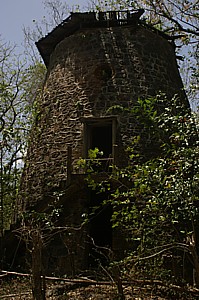
appearance. These conical structures are the remains of windmills that once
provided the power for the crushing of sugar cane in the production of
sugar.
By
the terms of the Treaty of Paris signed on 10th February 1763, the Seven
Years War was brought to an end and Tobago was ceded by the French to
Britain. Once Britain had formal control of Tobago, King George the Third
issued a royal proclamation allowing the sale of land in Tobago. Those
persons purchasing the land did so for the express purpose of developing
sugar plantations and by September 1770 the first cargo of Tobago sugar
reached England, having been exported from Studley Park Estate. Sugar became
the dominant crop and by 1836 there were 72 sugar estates in Tobago.
Each of these estates needed a power source to drive the rollers that
crushed the sugar cane to extract the juice that would be later boiled to
produce the sugar crystals. While animals such as mules and oxen could be
used these were expensive and so learning from the Dutch, the planters
erected windmills taking advantage of the steady Trade Winds that blow
across the island. So today as you drive around the south west of Tobago in
Riseland, Lowlands, Killgwyn, Cove, Shirvan and Bacolet these silent
sentinels to the sugar past are visible.
However as you proceed to the northern side of Tobago, sights of wind mills
recede and now topography gives a different view of sugar history. Southwest
Tobago is relatively flat land with only gentle undulating swells. The
northern side of Tobago is much more mountainous and here rivers flow down
from the Main Ridge Forest. Taking advantage of the rivers that would have
had strong water flow in the 18th and 19th centuries planters erected
waterwheels to drive the rollers for the crushing of the canes. Still
standing more than 100 years after it was fabricated in Scotland and erected
in Tobago is the waterwheel at Speyside. Another remaining example of these
waterwheels can be found just off of Franklyn's Road in Arnos Vale and here
can also be seen the remnants of the aqueduct that brought the water from
the river to the wheel.
While the waterwheels and many of the windmills merely stand as silent
reminders of the past, others have found new life showing us the past and
yet useful in the present. At the Mount Irvine Bay Hotel, site of the former
Mount Irvine estate, the windmill has been incorporated into the lobby of
the hotel. Along Shirvan Road the Watermill Restaurant has the tables laid
out under the cut stone roof of an abandoned watermill. At Courland Bay
Estate, Grange Estate, Friendship Estate and Bon Accord the old windmills
have been converted into houses.
Argyle Waterfall at 175 feet is the highest waterfall in Tobago. Located
just outside Roxborough, the entrance to the waterfall is on the Windward
Road and fairly easy to find as there is a large sign marking the entrance.
Once at the booth and having paid the entrance fee of TT$30 per person, you
are directed to an area for parking your vehicle and assigned a guide. Now
some may ask why do they need a guide as the walk to the waterfall is not
long about 15 - 20 minutes and the trail is well marked. The route to the
waterfall is more of a nature walk than a trek and the guides provide
information on the flora and fauna along the way enhancing the overall
experience of a visit to these falls. The trail is an easy one, suitable for
persons of all ages and the vegetation is lush giving the overall area a
very tranquil feel. Along the way if you are lucky you may get to see
several Blue-Crowned Motmot birds and these are truly beautiful to observe.
The
waterfall descends in a series of steps with three large pools with the
largest pool being at the base. Most individuals simply stay and enjoy the
pool at the base, however if you are adventuresome and in explorer mode
there is a trail at the side of the waterfall that enables you to ascend to
the higher levels. The trail up the side of the waterfall is more difficult
than the easy walk to get to the waterfall. At the second level there are a
series of rock pools that you can lie in and let the cool water flow over
you. Further up is the first pool that is not easily seen from the base of
the falls because of its height but this pool is deep enough for swimming.
The
waterfall is open to the public from 9am to 5pm daily. When taking a guide
it is strongly recommended that you ask to see their official guide badge
before departing from the booth so that you know that you are getting
someone who is knowledgeable and safe.
Charlotteville is a charming village on the northern tip of Tobago and as
you descend to the village via the Windward Road you get to see the village
spread out around the bay and hemmed in by the hills. At the foot of the
road at the intersection of the Windward Road and the Northside Road lies
the remains of an old "cocoa house". This simple structure underlies much of
the history of the village and was an important element in the ultimate
production of chocolate.
In
1865, Mr Joseph Turpin the Anglican Bishop of St Vincent, bought the two
principal estates in the area which were the 1,800 acre ‘Charlotteville
Estate” and the much smaller 150 acre “Pirates’ Bay Estate”. Mr Joseph
Turpin remained in St Vincent and gave the estates to his son Adolphus
(Edmond) Turpin and he in turn had managers to run the estates. The market
for Tobago sugar was however in decline and the managers began to convert
the estates to the production of cocoa, so that by 1900 they were fully
cocoa estates.
Cocoa trees flower all year round however only between 1% and 3 % of the
flowers develop into cocoa pods and in 6 months the pods are fully grown,
growing directly from the trunk and main branches. At this point the pods
are ready to be harvested with each pod containing between 40 and 50 beans
surrounded by a thick pulp. The pods are usually left to rest for about
three days and then cracked open to remove the beans and pulp which are
placed in wooden trays. The pulp then needs to be removed from around the
beans which led to the practice known as "Dancing the cocoa" where people
would literally dance on the beans so that their feet remove the pulp from
the beans. The combination of the feet and fermentation results in the pulp
leaving the beans and after approximately seven days the beans are placed in
drying trays for the heat of the sun to dry the beans. Being in a tropical
climate there is always the risk of rain which would ruin the drying process
and so in a twist of ingenuity cocoa planters devised a method where either
the drying trays were on runners or the roof of the cocoa house was on
runners so that if rain threatened the trays could be pushed under the roof
or the roof pushed over the trays.
Today in Charlotteville you can still see the cocoa house complete with
runners to allow the cocoa beans to be put under cover.
With
cocoa now being the predominant crop in the area there was need to transport
it from the area and from 1901 to 1960 there was a coastal steamer service
that made a stop in Charlotteville to collect the cocoa and other produce
for transport to Trinidad. Eventually as the road from Speyside developed it
became more important for the transport of the beans and eventually the
coastal service ceased in 1960. By 1990, however it was determined that
cocoa production was uneconomic and the estates plus the land occupied by
tenant farmers ceased producing cocoa. The economic life of the village then
began to depend more and more upon fishing and tourism.
Today there is a resurgence of interest in cocoa production in both Tobago
and Trinidad and it may be that we will see a resurgence of cocoa production
in Charlotteville.
Tobago may be home to the only dedicated goat and crab racing facility in
the world and indeed Tobago may be the goat racing capital of the world
because on Tobago goat racing is a serious competitive sport.
Goat Racing was started in Tobago in 1925 by Samuel Callender, who
interestingly was not a Tobagonian but a Barbadian. Goat Racing was
introduced as the poor man’s equivalent to the horse races, which was
controlled by the "moneyed class". At the time, Good Friday and Easter
Saturday were dedicated to marble pitching, Easter Sunday was a day of
feasting, and Easter Monday was for horse racing. As a result Tobagonians
created ‘Easter Tuesday’ in Tobago and dedicated it to the racing of goats
for the entertainment of the ‘lower classes’. Horse racing no longer exists
in Tobago and marble pitching no longer has its former prominence but goat
racing has thrived. In recognition of the importance that Tobago places on
goat racing, the Tobago House of Assembly has built a complex dedicated to
goat racing.
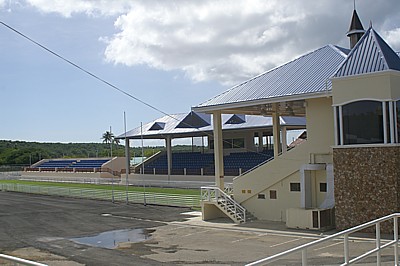
The goat racing
complex in the village of Buccoo has a main covered grandstand plus two
other stands with seating for hundreds of spectators. These stands are
designed so that everyone has a good view of the 100-yard grass track. The
complex also has a reception and information tower, museum, craft booths,
restaurant and bar, stables and car park.
In Tobago, not every goat is considered good enough to enter in the goat
racing competitions because this is serious business with stables, owners,
trainers and jockeys plus all the pride of winning and of course the
embarrassment that comes from losing badly. Individuals very carefully
select the goats that are used for racing and then begin the training. The
animals are trained for at least two months prior to racing and during this
period they learn to walk at increasing speeds until they’re running in
front of the trainer with a rope round their neck as on race day. A swimming
routine to build muscles is also a critical part of the training as is diet.
The jockeys must also train for these races as they do not ride on the goats
but must run alongside and be able to match the speed of their goats.
On Easter Tuesday, the village of Buccoo transforms itself from a sleepy
seaside village into beehive of activity for the goat races. Large crowds
attend the event and before each race the goats are paraded, with commentary
indicating the race favourites, and then the goats and jockeys proceed to
the starting gates. The jockeys, although they run barefooted, wear white
silk shorts and brightly colored jerseys. While Easter Tuesday is the main
day for goat races in Tobago, the popularity of the activity has led to it
taking place at other times in the year during events such as the Tobago
Heritage Festival. The nearby village of Mt. Pleasant has also begun to host
goat races although they do not have a dedicated facility.
The other aspect of the Easter Tuesday activity in Buccoo is the crab races.
In these races only the best bred and healthiest looking large blue crabs
are entered in these races. The crabs are harnessed with a piece of string
and then encouraged by much poking and prodding to run towards the finish
line. These crab races generate almost as much energy and excitement as the
goat races.
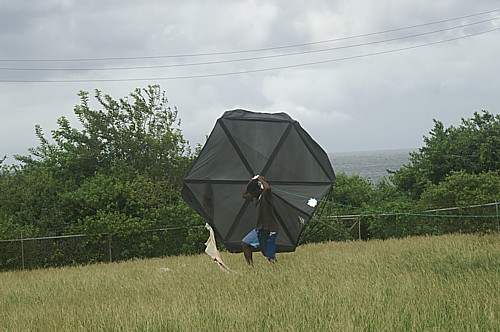
December is kite flying season in Tobago. While in
other islands, kite flying reaches its peak at Easter time, in Tobago
the month of December is when kites really soar. Those strong steady winds
that produce the waves which make December the best time for
surfing in Tobago, also make December the
peak time for kite flying in Tobago. Tobagonians like to put their kites in
the air and then leave them flying for several days so that there is the
constant sight of kites swaying in the wind. Accompanying the sight of the
kite is the steady drone that the kites make because the most popular type
of kite in Tobago is the
mad bull kite. While factory made kites can be seen in Tobago, most
people still make their own kites from scratch. Increasingly these home-made
kites are done using plastic which allows the kites to stay aloft for
several days, even in the rain.
Tobago's love of kite flying has led to several
competitions being held with the largest kite flying competition being on
January 1st on the Plymouth Recreation ground. Here children and adults come
to show their skill at kite making and kite flying with all sizes of
colourful kites being seen. In the large kite category teams are often
required to get these kites aloft as some of these kites are over 12 feet in
size and one person cannot hoist such a large kite. In addition, once the
kite is in the air, it takes a strong person or several to hold onto the
kite. In fact there have been instances where the kite hoisted the person
aloft and many have taken to tying the kite to a post to prevent being
dragged airborne. These teams are often organised by villages as everyone
competes for the prizes but more importantly for the bragging rights that
come with their village team having won the competition. You can see
pictures of the 2010 Plymouth kite flying competition by visiting the
Caribbean Outdoor Life Photo Gallery.
The Tobago Jazz Experience is organized by the Tobago House of Assembly in
the last week in April of each year. This is one week to 10 days of music
shows in Tobago. The highlights of the Jazz Experience are shows which
feature local and international artists. While the shows with the
international artists have an entrance fee many of the other shows are free.
There are also several side events during the week and one of these side
events is called Jazz on the Beach. Held on Mount Irvine
Beach and organized and sponsored by the Mt Irvine Bay Hotel this show has
been running for several years and is held on the Saturday and Sunday
afternoon.
The location of Jazz on the Beach provides a beautiful ambiance, with the
stage set on the sand, with almond trees providing shade for the listeners
and the blue water of the sea as a type of side screen. This is a relaxed
jazz experience with the audience generally clad in swimming clothes. While
the music plays the audience sits or dances on the sand, bobs in the water
or drifts on top the water admiring the beauty of the underwater world while
enjoying the sounds of the jazz.
Mt Irvine Beach is a lovely beach for snorkeling. On the southern end of the
beach just a few feet offshore is a coral reef so that with a few strokes
you are over the reef. This reef is composed of scattered coral rock
outcrops so there are canyons and valleys to explore. There are no waving
sea fans or soft corals but hard corals throughout. During the Jazz
sessions, the water near the shore gets full of people as many members of
the audience take to the sea to enjoy the music while soaking in the salt
water. Even during the jazz however there is sea life to observe, one simply
has to move further out. On weekday mornings and indeed even on weekday
afternoons this is a very quiet beach so the sea life can be found closer
inshore. On the northern end of the beach, part of the reef is raised above
the water at low tide while at high tide the water covers most of the reef
except the top. The northern end therefore also provides an area for
snorkeling.
Every Sunday night there is a local affair in Buccoo Village Tobago that has
been going on for decades. Known as Sunday School, this weekly street party
is a key element of night time entertainment in south-western Tobago. Over
the years Sunday School had degenerated into a dark hall that was a pickup
point for tourists looking for local companionship against a backdrop of
Jamaican dub music. However, Sunday School has rejuvenated itself and now
compares favorably with other weekly Caribbean street parties such as
Fish Friday in
Gouyave Grenada, the
Anse
La Raye Fish Feast and the
Gros Islet
street party in St Lucia and the Friday night
Fish Fry at Oistins in Barbados.
Buccoo is a small village in the south-west of Tobago known for its
goat and crab races on Easter Tuesday and
also as a location for boarding boats to view the Buccoo Reef. Buccoo
village is however best known for Sunday School, which is a weekly event
held every Sunday. Beginning from 8pm and lasting till after midnight, this
street party brings the entire village to life. As you enter the village the
shops and bars are open and there is a feeling of excitement in the air. As
you proceed down the gentle hill there are craft and souvenir vendors on
either side of the road and the excitement builds. Finally at the base of
the hill with a backdrop of fishing boats gently bobbing in the water is
the Buccoo Integrated Facility with the beach side facilities
and the heart of the action.
Sunday School is a party and no party would be complete
without music. In Buccoo’s Sunday School, music and dancing are the main
highlight of the evening. Every Sunday night in
the courtyard of the Buccoo Integrated Facility there is live steel band
music and people sit and listen to the band
and couples dance under the stars. Later when the players take their rest, the D.J.
provides the music.
The music, the tang of the salt air, the gentle breezes and the star light
all combine to create an enjoyable ambiance. The mixed crowd of Tobagonians,
Trinidadians and foreign tourists mingle freely enjoying the night. So that
besides the music the people watching is fantastic. As the night wears on
and the area fills you can stand on the side walks and watch the passing
parade of people and cars.
Whenever you are thirsty obtaining liquid refreshment is easy as every bar
in the vicinity is open. If at any point in the night you feel for a bite,
the restaurant on the upper floor of the Buccoo Integrated Facility is open
and
there is an array of food vendors with a variety of meals on offer. If you
do not want a heavy meal, ice cream and other local snacks are easily
acquired.
So
the next time you are in Tobago go on down to Sunday School. Its clean, its
free and its open air.
The
Moravian church was established in Tobago in the 1780’s when a plantation
owner, Mr. John Hamilton with the support of the French Governor Comte
Dillon, invited the church to send missionaries to preach to his slaves.
According to Douglas Archibald in his book, Tobago Melancholy Isle, in 1789
the church sent John Montgomery in April 1790. Unfortunately in October 1790
his wife, Mary, died and worn out from his efforts Mr Montgomery left Tobago
in 1791. In 1792, Mr. Hamilton continued his efforts to get the Moravians
established but that second attempt failed. In 1798 a third attempt failed
until finally in 1827 a Moravian church was established in Montgomery which
lies in the middle of the villages of Mount Irvine, Riseland, Bethel and Old
Grange.
From
its start in 1827, the Moravians (United Brethren) went on to establish
churches at Mount Pleasant (1839), Moriah (1840) Bon Accord (1861) Back Bay
(1958) Black Rock (1869) Bethesda (1874) Buccoo (1996). The Moravian Church
is particularly noteworthy for the fact that it came to Tobago to provide
Christian teachings to the slaves. It was one of the first religious bodies
to establish primary and secondary schools in the West Indies for slaves.
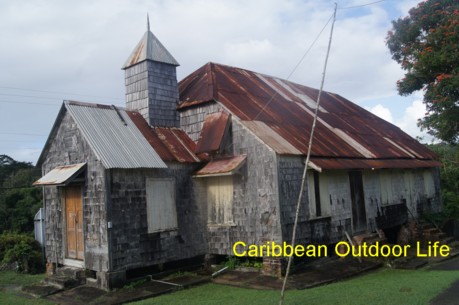
Today in the village of Montgomery a Moravian Church still stands on a
beautiful hilltop with a view of the villages all around and the ocean in
the distance. The Montgomery church has been rebuilt as a modern concrete
building but in the villages of Spring Garden and Black Rock, two of the
earlier wooden churches still exist.
The
Spring Garden Moravian Church is over 100 years with the original building
being constructed in 1852 on the ruins of an old sugar factory. Although the
church has constructed a new concrete church building the original church
building still stands on the grounds and is used as a sanctuary and
corrective learning center. The Spring Garden Moravian Church is very easy
to find as one simply turns onto the Orange Hill Road at the intersection
with the Claude Noel Highway (the intersection with the NP Gas Station) and
drives for 5 minutes along that road.
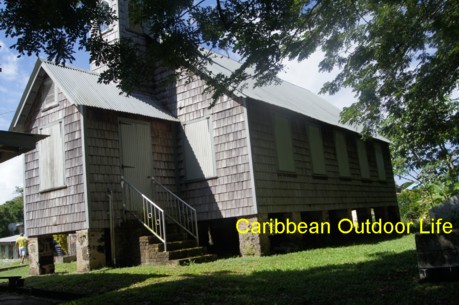
The
other wooden Moravian Church is in the village of Black Rock and is in
better physical condition than the Spring Garden church. The Black Rock
Moravian Church was built in 1869 but in 2003 the church underwent a
restoration process and in 2009, the church won an award from the Tobago
House of Assembly for the Best Historic Restoration Project (Small). The
Black Rock Moravian Church is easily found as it is visible from the main
road.
Colonial era fortifications are always a tourist attraction throughout the
Caribbean. In Tobago, Fort King George is the best known of such forts. Fort
King George however is not the only military structure that you can see in
Tobago. Many of these other forts still remain and are scattered all over
the island. It seems that wherever you stay in Tobago there is a fort near
you.
On the westernmost tip of the island near to the Crown Point airport lies
Fort Milford, with its cannons still also pointing out to sea. Built in 1642
by Dutch settlers the fort derived its name from the town of Milford that
had been planned for the area where the airport is now located. Originally
called Belle Vista, the fort still provides pleasant views and is an
enjoyable place to relax and watch the sunset.
The Black Rock area provides the opportunity to explore the remains of Fort
Bennet, which was originally constructed in 1680 by the Courlanders from
Latvia. The settlers were headed by an English mercenary named Lt. Robert
Bennet, after whom the fort was named. It was abandoned in 1681 as
Amerindian aggression drove the settlers from the
area. In 1778, the British rebuilt the fort as protection from privateers
for the sugar cargoes that were shipped from that area. The area around Fort
Bennet now provides magnificent views of Turtle Beach and Grafton
Beach.
Betsey’s Hope is an interesting name as it is not the type of name that you
would normally associate with a military fort. Yet there is a fort at
Betsey’s Hope on the Windward Road between Belle Garden and Roxborough.
Betsey it turns out was the wife of one of the slave masters and she had
hoped that slavery would be abolished. The village that developed around
the 600 acre estate drew its name from her. The estate was on the sea at
Queen’s Bay and in the 1700’s piracy plus attacks by foreign nations was to
be feared, so a military battery was erected to protect the estate.
It seems that wherever you go in Tobago there are forts throughout from
Charlotteville to Plymouth to Studley Park.
It is said that Tobago was the most fought over island in the Caribbean,
changing hands 31 times. As a result of the numerous battles for Tobago,
forts were erected at many points around the island and the remnants of many
of these can still be found on the island, with Fort King George
being the best preserved. One of the easiest fortifications for visitors to
observe is Fort Milford being located a few minutes’ walk from the airport
at Crown Point.
Built in 1642 by Dutch settlers the fort derived its name from the town of
Milford that had been planned for the area where the airport is now located.
The Dutch presence in Tobago goes back to the 1620s. They wanted Tobago as a
first base for their excursions into Guyana, where they were creating
colonies on the Demerara and
Essequibo Rivers. From about
1770 the British army maintained a picket post there and the militia manned a
two cannon battery on the site until the island fell to the French in 1781.
As part of the American War of Independence, the French had joined the war
on the side of the Americans and in May 1781 they sent a fleet under the
command of the Comte de Grasse to attack Tobago. The French landed troops
commanded by the Marquis de Boullie and captured the island on 2nd
June 1781. In 1793, the British re-conquered Tobago.
In 1811, the British enhanced the fortifications at Fort Milford. This work
on the Fort was meant to help protect the sugar industry which was extremely
profitable at the time. The British maintained a garrison at Fort Milford
until 1854 when they withdrew troops from the island of Tobago.
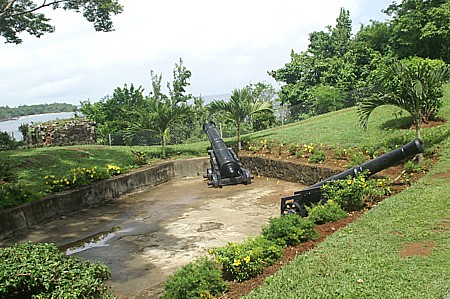
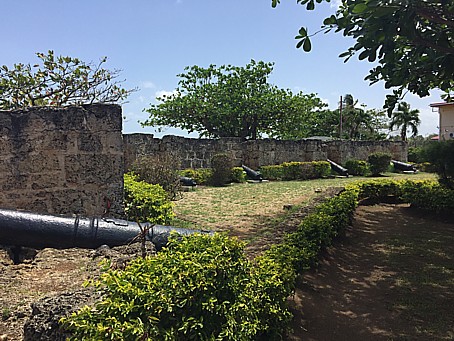
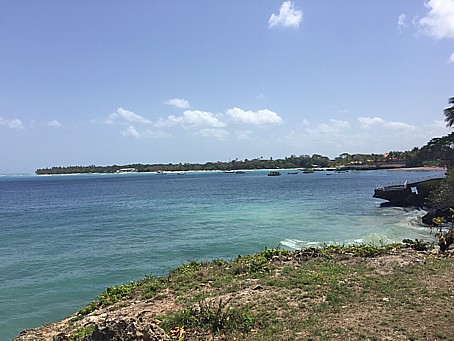
Originally Fort Milford was called Belle Vista and even today it lives up to
that name with a wonderful view of Store Bay. Nowadays, most visitors come
to stroll around the peaceful gardens, which are well maintained, observe
the old fort walls that are made of cut coral limestone, see the cannons
that still point out to sea and enjoy the tranquility and views. With the
added benefit of a security officer stationed at the fort during the day,
Fort Milford is an enjoyable place to relax and watch the sunset.
Fort Monck is located at Rocky Point which is a small peninsula on the
southwestern coast of Tobago in the Mount Irvine area, shortly after the
Mount Irvine Bay Beach Facility. Indeed, one side of Rocky Point overlooks
the Mount Irvine Bay Beach facility while the other side overlooks Back Bay.
Fort Monck is probably the second oldest fortification in Tobago.
Constructed in 1681 by a group of Courlanders, who at the time were under
the command of Colonel Franz Monck, it was constructed to either supplement
or replace a fortification that was built at Stone Haven Bay by a small
advance group of soldiers under an English lieutenant in Courlander service,
called Robert Bennet. The group of soldiers under Robert Bennet came under
regular attacks by Indians from the Windward Islands and eventually left
Tobago in 1681, apparently just before the arrival of a group under the
command of a Scottish colonel in Courlander service, called Franz Monck.
Monck, was accompanied by a mixed group of 135 settlers consisting of
Scotchmen, Germans, Danes and Latvians. Finding the colony a bad shape, he
decided to construct a new fortification at Rocky Point between Mount Irvine
Bay and Stone Haven Bay. The fort was built using coral stone in a horseshoe
layout, with earth embankments and housed a battery of six cannons. There
was a two-storey powder magazine incorporating a barrel-vaulted magazine
store, with a dressed stone lintel above the door and rifle-holes with brick
detailing Amerindian archaeological remains.
Monck was soon assaulted by members of the Kalinago Tribe from St Vincent
and St Lucia, aided by French pirates. In addition Monk's group was not
receiving supplies from Europe with many of the supply ships vanishing
before reaching Tobago. Also Monck’s group was also afflicted by various
illnesses. The Couronian soldiers deserted and fled to Barbados. So in 1683,
Monck and the remaining settlers left Tobago.
Despite the departure of Monck and his group this was apparently not the end
of Fort Monck. It is believed that the British used this fort in the 1780’s.
It is also claimed that this site served as a coastal defense battery during
World War II with the purpose of protecting the island’s coast from
potential enemy attacks. The battery consists of a series of gun
emplacements and bunkers, which are still visible today.
Today the powder magazine still remains along with the first two rows of the
outer coral stone walls.
The first organized European group to settle in Tobago were the
Courlanders who came primarily from the area that today is called Latvia and
they mainly settled around the area of Plymouth and Great Courland Bay. As
part of their settlement, they would have built fortifications. In 1636, the
Spanish from Trinidad allied with the Kalinago from Toco attacked Plymouth
Tobago and destroyed their settlement taking the 65 soldiers to work as
slaves in Margarita.
In 1654 another group of 80 families came to Tobago, consisting of
Latvians, Germans, Dutch, French and British arrived and settled around
Plymouth. They erected the fort that was named after Jacobus, the Duke of
Courland and is now called Fort James and settled around the Courland Basin.
The fort was manned by 124 soldiers.
In November 1659 the Dutch who had settled on the Scarborough side of
Tobago attacked the Courlanders at Plymouth. The Courlanders surrendered
without much resistance and turned Fort James over to the Dutch.
Over the years the fort was seized alternately by the English and French.
In 1762 under the British, the military restored the fort, building
permanent barracks in 1768. Two companies of the 4th and later the 62nd and
70th regiments were quartered in the barracks. In November 1770 the fort was
attacked by rebellious slaves. In 1777 the defenses were strengthened with
the positioning of a four gun battery consisting on three 18 pounder guns
and one 16 pounder cannon.
The fort was captured by the French in 1781; recaptured by the British in
1793; occupied yet again by the French in 1802 and passed finally to the
British in 1803. The ruins of Fort James remain today on the headland of
Courland Bay, just outside the village of Plymouth.
The surviving remains of the fortification include a series of low walls
made of cut coral limestone, and face volcano stone with brickwork at their
corners, a powder magazine and a brick oven incorporated in a rectangular
bastion – like structure. The limestone walls of the power magazine cut an
older wall made of brick. This complex is provided with four cannons, two
show the Tudor double- rose while the other two other ones are marked GR
(Gorge Rex).
Going cycling in Tobago is easy and almost every area is good for cycling
plus bicycles are easy to rent, especially in the Crown Point area. Adding
bicycling to your holiday itinerary is a wonderful way to get some exercise
plus see parts of the country. Because of the slower pace at which you move,
having a ride on a bicycle often allows you to see items that you often
would have missed.
In this article we highlight some areas around the more popular vacation
areas in Tobago where you can go cycling while on holiday in Tobago
Crown Point
The Crown Point area is the section of Tobago where the majority of persons
on holiday spend their vacation. Being composed of mostly flat land, this
part of Tobago is the easiest to ride for someone looking for a casual
bicycle ride. From the airport you can cycle around the airport perimeter
and down a slight incline to the beach. At the beach you can stop and look
at the airplanes on their final approach to the runway. As you continue
along, the road runs parallel to the airport runway and there are several
side traces, all of which lead to Kilgwyn Bay.
Storebay Local Road
Storebay Local Road is located just outside the entrance to the airport and
is a long straight stretch of flat road with many of the smaller apartment
hotels along the road. At the eastern end of the road, the paved section
ends but the road continues with packed earth and gravel. At the end of this
road there is another road on the right that leads down through
Kilgwyn Swamp.
Continuing along this road gives you the opportunity to see several species
of swamp birds such as hummingbirds, herons, jacanas and egrets. Eventually
the road through the swamp ends on beautiful Kilgwyn Beach.
Pigeon Point
The road leading into Pigeon Point is bordered on one side by the sea and on
the other side by a mangrove swamp. This road always provides an interesting
casual ride as scattered along the sea side are vendors of various local
craft items, while in the water can be seen yachts and fishing boats. At
different times during the day, usually in the mornings and early evenings,
local fishermen return to the shore with their catch of fresh fish and
lobster. As Pigeon Point is on the western side of Tobago in the evenings
you are often treated to the sight of a magnificent sunset.
Bon Accord
Wetlands
A ride through the Bon Accord wetlands is a great way to combine gentle
bicycling with some bird watching. This area is probably the top location to
see some of Tobago's wetland bird species. In this area are often found
Whistling Ducks, Red-hooded Woodpecker, Great Egrets, Black-Crowned Night
Herons and others. The ride takes you through a developed area of holiday
homes and then on to the undeveloped section which is a wetland area
bordering on the sea. To get to the Bon Accord wetlands you can turn off the
Claude Noel Highway at several points – Bon Accord Estate Road or Alfred
Walk or Shade Road.
Cove
Further along the Claude Noel Highway heading from the airport to
Scarborough is a sign indicating the entrance to the Cove Industrial Estate.
An industrial estate is not somewhere that many people would first think of
as a place for a relaxing bicycle ride yet this industrial estate is such a
location. The road leading into the estate is a long straight road bordered
by tall trees with grassy open areas behind. Along this road is the entrance
to Canoe Bay Resort. At the end of the road is the TTEC Electricity
Generation plant but one can go past the plant along a gravel road and
continue in the wooded area. This area is cool and peaceful in the early
mornings. A similar ride can be done using Friendship Road which is just
before the Cove Estate Road.
Lambeau
Beginning at the edge of the Tobago Plantations Resort at the Claude Noel
Highway is the Lambeau Old Road (some persons call this the Milford Road)
and cycling along this road is a wonderful ride along the edge of the ocean
with coconut palms and a strong breeze coming in off the ocean plus scenes
of windsurfers moving along the wave tops. Lambeau Road eventually climbs an
incline and goes through Lambeau village before descending again to the sea.
One can continue along this road until the edge of Scarborough.
Shirvan-Buccoo Road
While the Shirvan Road can be busy at times with cars zipping past it can
still be an enjoyable ride if one does not mind the occasional car speeding
past. The section of this road that goes past the Mount Irvine Golf Course
and then down to Grange Beach climbing to the entrance to the Mount Irvine
Hotel and then down again to Mount Irvine Beach can be very pleasant in the
early mornings with the views of the golf course and then the sea. Another
enjoyable section of this road is the area beginning around Grafton Hotel.
As part of your ride you can follow the signs on the Buccoo Road down to
Fort Bennet to see the remains of an old fort and then back onto Buccoo Road
and through the village of Black Rock and going past Turtle Beach Hotel
along a long stretch with its coconut trees and azure blue ocean until the
entrance to Plymouth village
Buccoo Road
This ride can be started at the three way intersection of Shirvan Road,
Belmar Trace and Buccoo Road on the corner where Me Shells Restaurant is
located. This road goes through the flat area containing the village of Mt
Pleasant and into the village of Carnbee. As you go through this area you
see the typical village life of Tobago with small shops and vegetable
stalls, the area where the steelband practices and the village football
field.
Golden Grove Road
Off Shirvan Road is Golden Grove Road, which winds down through a cool
forested area with small streams flowing through the area and then goes past
the Latour Farm with its herd of red Hope cattle. At the southern end of
Golden Grove Road it joins onto the Claude Noel Highway however before the
junction with the Highway one can swing onto the various side streets and
explore the back areas in Caanan Village.
Buccoo Bay Road
A short but interesting ride is to go along Buccoo Bay Road which starts on
the Shirvan Road at the edge of the Mount Irvine Golf Course and runs gently
down hill and goes past the
Tobago goat racing complex and then past Buccoo Bay with its fishing
boats bobbing on the sheltered waters of this bay. Continuing past the bay,
the road goes up a short incline and leads to a promontory overlooking the
ocean.
While each of these riding areas has been described separately, one of the
many nice things about Tobago is that depending upon how much exertion you
want to engage in you can combine several of these rides to extend your
cycling.
To learn more about Tobago, visit our other Tobago Pages: